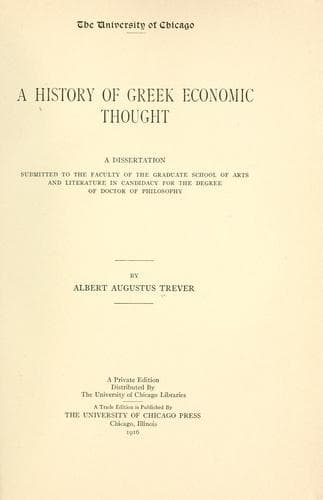
A History of Greek Economic ThoughtTrever, Albert Augustus
History
A History of Greek Economic Thought
Trever, Albert Augustus
Economics -- Greece -- History; Thesis (Ph. D.)
Of course, the bald theory that, in exchange, one necessarily loses what
the other gains, is untenable. Yet there is still something to be said
for Aristotle. He recognized, as well as Menger, that exchange, as
pursued by the retailers, did not square with his idea of just price.
This is the very reason why he objects to retail trade. He is presenting
exchange, not as it is, but as he believes it should be pursued. His
doctrine, in a nutshell, is that the primary purpose of exchange is
profit, _defined as economic satisfaction of mutual needs_, not profit
in dollars and cents. The equality that he seeks, too, is not so much an
equality of value in obols and drachmas, but that each shall receive an
equal quantum of economic satisfaction. This is the true standpoint at
bottom, and when, as is common, the mere purpose of money-making
dominates in the pursuit of exchange, the profit is too often at the
expense of the other party. Such exchange certainly does not mean
economic advance or general prosperity. It merely makes possible an
increase in the inequalities of wealth and poverty. There is much of
fallacy in the prevalent idea that business necessarily increases the
wealth of a state. Ruskin, though like Aristotle extreme and one-sided
in his view, struck at the root of this error. He also declared that the
result of exchange should be advantage, not profit, and repudiated the
idea that the mere fact that goods change hands necessarily means
general enrichment.[729] The central truth in their protest needed to be
spoken, though both erred in not sufficiently recognizing that the labor
involved in exchange creates an added time and place value, and
therefore has a right to be called productive. They also failed to
observe the fact of the necessary risk involved in the business of
exchange, which should be repaid with a fair additional profit. For the
cornering of markets and the manipulation of prices, for the sake of
individual enrichment, modern economists and statesmen, with Aristotle
and Ruskin, are fast coming to have only words of protest.
Moreover, contrary to Barker’s assertion, demand, as an element of
price, is prominent throughout this discussion of Aristotle. He objects,
however, to allowing the effect of demand to overcome unduly the cost of
production, thus causing inequality and injustice. According to his
idea, each receives the equivalent in value of what he gives, in the
sense that it is a resultant of the proportionate influence of both cost
and need.[730] We may, nevertheless, observe an excellent example of
inconsistency in the fact that, despite his insistence upon just
exchange, he appears to treat monopoly as a legitimate principle of
finance for both men and states,[731] though his intention in the
passage may have been to discuss actual conditions, rather than to
idealize.
Public-domain text, read in full here on John Shaqi.
Reviews
Reviews
No reviews yet
Be the first to share your thoughts on this work.
Elsewhere in the archive
Join the Discussion
Join the discussion
Sign in to leave a comment or review.
Sign InorCreate an account