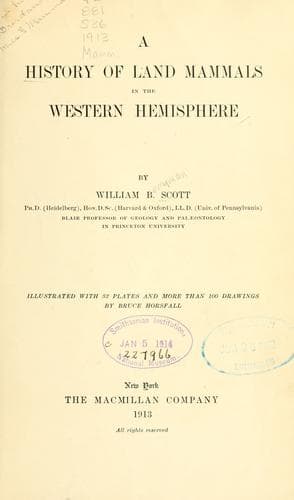
A history of land mammals in the western hemisphereScott, William Berryman
History
A history of land mammals in the western hemisphere
Scott, William Berryman
Mammals; Mammals, Fossil
To every one who has paid the slightest attention to the subject, it is a
familiar fact that different parts of the earth have different animals;
school-children learn from their geographies that kangaroos are found
in Australia, the Hippopotamus in Africa, the Tiger in southern Asia,
armadillos and llamas in South America. These examples are all taken from
distant lands, yet the zoölogical difference between two given land-areas
is by no means proportional to the distance between them. An Englishman
landing in Japan finds himself surrounded by animals and plants very
like and often identical with those which he left at home, while the
narrow Strait of Lombok, east of Java, separates two profoundly different
regions. In crossing Mexico from east to west, the traveller meets very
different animals in closely adjacent areas; and, at first sight, the
arrangement of animals appears to be so capricious as to admit of no
formulation in general laws.
In pre-Darwinian times, when it was the almost universal belief that
each species had been separately created and was exactly fitted to the
region which it inhabits, no explanation of the geographical arrangement
of animals was possible, but the acceptance of the theory of evolution
demanded that such an explanation should be found. A failure to devise
any rational and satisfactory account of the geography of animal life
would be a fatal weakness in the evolutionary theory, hence the facts of
distribution were subjected to a renewed and searching analysis as one
of the best means of critically testing the new doctrine. Not that the
subject had received no attention before the publication of Darwin’s
book; on the contrary, it had attracted much interest as a study of
facts, and this study was one of the principal avenues by which Darwin
approached his great generalization. In his autobiographical fragment
he tells us: “I had been deeply impressed by discovering in the Pampean
formation great fossil animals covered with armour like that on the
existing armadillos; secondly, by the manner in which closely allied
animals replace one another in proceeding southward over the Continent;
and third, by the South American character of most of the productions of
the Galapagos archipelago and more especially by the manner in which they
differ slightly in each island of the group.”
Obviously, before attempting to explain the facts of the geographical
distribution of mammals, we must first ascertain what those facts are.
The following brief sketch of the terms used in describing geographical
arrangement is summarized from Mr. Wallace’s “Island Life.”
Public-domain text, read in full here on John Shaqi.
Reviews
Reviews
No reviews yet
Be the first to share your thoughts on this work.
Elsewhere in the archive
Join the Discussion
Join the discussion
Sign in to leave a comment or review.
Sign InorCreate an account