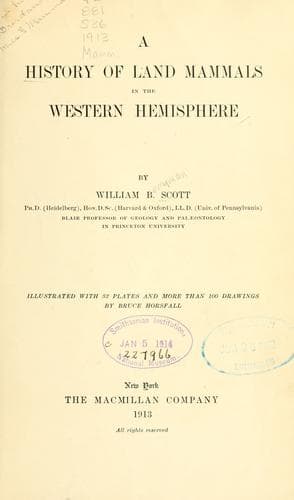
A history of land mammals in the western hemisphereScott, William Berryman
History
A history of land mammals in the western hemisphere
Scott, William Berryman
Mammals; Mammals, Fossil
A remarkable example of the widely separated areas of species belonging
to the same genus is that of the tapirs. Of this genus there are two
or three species in Central and South America and one inhabiting the
Malay Peninsula and Borneo, almost as wide a separation as the size of
the earth permits. Discontinuous distribution of this character can be
explained in terms of the evolutionary theory only in one of two ways.
Either (1) the American and Asiatic species developed independently of
one another from different ancestors, or (2) the regions intervening
between these widely separated areas once formed a continuous land,
occupied by species of the genus which have become extinct. From all that
we know concerning the operation of the evolutionary process, the first
alternative may be set aside as altogether improbable, and, even had we
no information concerning the history of the tapirs and their former
distribution, the second explanation would be chosen as incomparably the
more likely. As a matter of fact, we have definite knowledge that tapirs
once ranged all over Europe and North America and doubtless over northern
Asia, as well, and, further, that North America was joined to Asia by a
land occupying the place of the shallow Bering Sea, at a time when the
tapirs were able to take advantage of this means of passing from one
continent to the other. Such appears to be the invariable explanation of
discontinuous distribution, though we may not always be able to give so
clear a proof of it.
The genera of a family are distributed in much the same fashion as the
species of a genus, but, as a rule, much more widely. While no genus of
terrestrial mammals is cosmopolitan (_i.e._ universally distributed),
at least as genera are defined and limited by most modern systematists,
certain families are represented in every continent. If the extremely
peculiar and isolated Australian continent be excepted, the number
of such cosmopolitan families is considerable and wide separation
between the genera is frequent. Of the camel family, for instance, one
genus, that of the true Camel (_Camelus_), is confined to the northern
hemisphere and the Old World, the other (_Lama_), comprising the Llama,
Guanaco, etc., is found only in the southern hemisphere and the New
World. Less extreme instances of the discontinuous distribution of a
family are common enough.
The principles of distribution are the same when applied to families and
orders. Most of the mammalian orders are very widely distributed and many
are cosmopolitan, except for Australia, though some are confined to one
or two continents. The monotremes are limited to Australia and Tasmania,
the marsupials to Australia and the Americas, the edentates to the
latter, the elephants and hyracoids to Africa and Asia. Carnivores and
rodents, on the contrary, are found in every continent, even Australia.
Public-domain text, read in full here on John Shaqi.
Reviews
Reviews
No reviews yet
Be the first to share your thoughts on this work.
Elsewhere in the archive
Join the Discussion
Join the discussion
Sign in to leave a comment or review.
Sign InorCreate an account