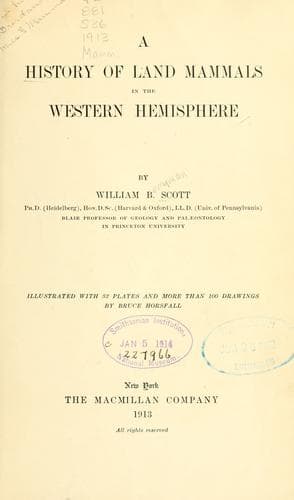
A history of land mammals in the western hemisphereScott, William Berryman
History
A history of land mammals in the western hemisphere
Scott, William Berryman
Mammals; Mammals, Fossil
Dr. J. A. Allen has reached closely similar conclusions. “Of strictly
climatic influences, temperature is by far the most important, although
moisture plays an influential part. Where a low temperature prevails
life, both animal and vegetable, is represented by comparatively few
forms; under a high temperature it is characterized by great diversity
and luxuriance. Within the Arctic Circle the species of both animals
and plants are not only few, but they are widely distributed, being for
the most part everywhere the same. Under the tropics they are a hundred
fold more numerous and of comparatively restricted distribution.” “The
influence of temperature is perhaps most strikingly displayed in the
distribution of life upon the slopes of a high mountain, especially if
situated near the tropics. While its base may be clothed with palms
and luxuriant tropical vegetation, its summit may be snow-capped
and barren.... The animal life becomes likewise correspondingly
changed, tropical forms of mammals, birds, and insects of the lower
slopes gradually giving place to such as are characteristic of arctic
latitudes.” “The effect of humidity upon plant life is thus obvious,
but it is equally potent, though less evident, upon animal life. Many
animals ... are so fitted for a forest life, as regards both food and
shelter, that their very existence depends upon such surroundings....
Thus moisture alone may determine the character of life over extensive
regions.”
While climate is thus the most important of the barriers which determine
distribution in continuous land-areas, the absence of any particular
species from a given region is no proof that the climate is unsuitable
to that species. This is sufficiently shown by the manner in which
animals introduced into a new country often run wild and multiply to an
incredible extent, as the rabbits have done in Australia, the Mongoose in
Jamaica, horses on our western plains, horses and cattle on the Pampas of
Argentina, etc.
Topographical features, such as great mountain-ranges and plateaus,
also limit many species, not only by the difficulty of crossing them,
but also by the effect which they have upon temperature and moisture.
For this reason long ranges of mountains and table-lands may carry a
northern fauna very far to the south of its ordinary range, as do the
mountain-systems of North America in a very conspicuous manner. The
great Mexican plateau is zoölogically a part of North America, while the
low coastal lands as far as southeastern Texas have Central American
affinities.
Public-domain text, read in full here on John Shaqi.
Reviews
Reviews
No reviews yet
Be the first to share your thoughts on this work.
Elsewhere in the archive
Join the Discussion
Join the discussion
Sign in to leave a comment or review.
Sign InorCreate an account