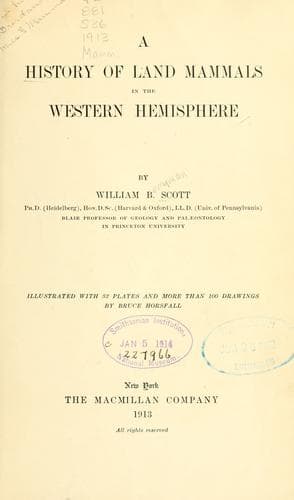
A history of land mammals in the western hemisphereScott, William Berryman
History
A history of land mammals in the western hemisphere
Scott, William Berryman
Mammals; Mammals, Fossil
In considering the mammals of this subregion, it should be remembered
that they are not uniformly distributed throughout even one subdivision,
but in a scattering way and in accordance with their habits and stations,
and also in accordance with a gradual change to the south, following the
changing temperature. The Muskrat will not be found far from water or the
Porcupine from woods. Especially characteristic of the Canadian subregion
are the Old World types of deer, none of which range farther south than
the Transition zone. The Wapiti, erroneously called the Elk (_Cervus
canadensis_), is very closely allied to the European Stag (_C. elaphus_)
and still more closely to the Stag of the Thian Shan in Central Asia (_C.
eustephanus_). So great is the resemblance, that some naturalists would
refer all three forms to a single species. The Moose (_Alce americanus_),
which should be called the Elk, is so near to the Scandinavian Elk (_A.
machlis_) that it is hardly distinguishable as a separate species, and
the Woodland Caribou (_Rangifer caribou_) is the American representative
of the Lapland Reindeer (_R. tarandus_). The so-called Rocky Mountain
Goat (_Oreamnos montanus_), a peculiar and aberrant form of the Chamois
subfamily of the Antelopes, is confined to the subregion. The Mountain
Sheep (_Ovis montana_, _O. dalli_) are represented by three or four
species, one of which extends into the Sonoran region, as does also the
Bison, wrongly called Buffalo (_Bison bison_), which is nearly allied to
the European _B. bonasus_. In Cæsar’s time the European Bison (German,
Wisent) ranged through Germany and is described in his account of the
Hercynian Forest; but the advance of civilization has almost exterminated
it, only a few small herds being maintained by the most rigid protection
in Russia and in the Carpathian Mountains. Of the Carnivora, the weasels,
martens, Fisher, Mink and Ermine are Boreal, as are the Wolverene
(_Gulo_) and the Grey Wolf (_Canis_), the three last-named extending also
into the Arctic zone. Essentially Boreal, though reaching and entering
the Sonoran, are the bears (_Ursus_), the red foxes (_Vulpes_), the
otters (_Lutra_) and the Old World shrews (_Sorex_), while the Star-nose
Mole (_Condylura_) and the mole-shrews (_Urotrichus_) do not extend
south of the Transition zone. Probable intruders from the south into the
Boreal subregion are the pumas, or “mountain lions,” which just enter
the subregion, the Canada Lynx (_Lynx rufus_) and one species of skunks
(_Mephitis_), the Raccoon (_Procyon lotor_), Badger (_Taxidea americana_)
and the American deer (_Odocoileus_). A large number of rodents are
characteristically Boreal: marmots, or woodchucks (_Marmota_), the
Sewellel (_Aplodontia rufa_), lemmings (_Myodes_), Jumping Mouse
(_Zapus_), the Canada Porcupine (_Erethizon dorsatus_) and the pikas,
“tailless or whistling hares” (_Ochotona_). Boreal rodents that enter the
Public-domain text, read in full here on John Shaqi.
Reviews
Reviews
No reviews yet
Be the first to share your thoughts on this work.
Elsewhere in the archive
Join the Discussion
Join the discussion
Sign in to leave a comment or review.
Sign InorCreate an account