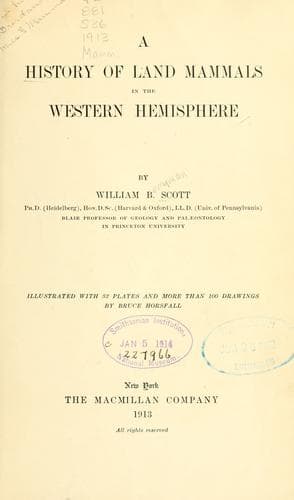
A history of land mammals in the western hemisphereScott, William Berryman
History
A history of land mammals in the western hemisphere
Scott, William Berryman
Mammals; Mammals, Fossil
The fauna of the Central American subregion is less rich and
characteristic than that of the Brazilian and is, to a certain extent,
transitional to that of the Sonoran region of North America, several
genera proper to the latter region extending into it, which are not known
to pass the Isthmus of Panama, such as shrews, a fox and one of the
pocket-mice. The West Indian islands are exceedingly poor in mammals,
a great contrast to the East Indian, or Malay, Archipelago; only a few
rodents, insectivores and bats occur in them.
CHAPTER VII
THE SUCCESSIVE MAMMALIAN FAUNAS OF NORTH AND SOUTH AMERICA
The natural method of telling a story is to begin at the beginning and
go on to the end, but to deal in that manner with the many different
assemblages of mammals which have in turn inhabited the western
hemisphere has the great drawback of beginning with a time when
everything was utterly strange to the modern eye. Could the reader be
carried back to the far distant days of the Paleocene epoch, he would
find himself in a completely unfamiliar world; and there is therefore a
real practical advantage in reversing the story and starting with the end
and thus proceeding gradually from the more to the less familiar. The
foregoing chapter gave a sketch of the more striking and characteristic
mammals which inhabit the Americas to-day, and we may now take a step
backward to the epoch immediately preceding our own, the Pleistocene.
As was shown in Chapter V, the Pleistocene was a time of many and great
climatic vicissitudes, periods of cold, when the northern part of the
continent was buried under great ice-sheets, alternating with far milder
periods, when the climate was much as at present, or even warmer. These
climatic changes necessitated many changes in the distribution of
animals and plants, increasing cold driving them southward, while the
return of more genial conditions permitted the northward migration of
southern forms. The effects of these changes of climate are still plainly
visible in the geographical arrangement of living beings in the northern
continents and many anomalies of distribution, otherwise inexplicable,
are thus made clear. Attention was long ago directed to the fact that
the tops of high mountains support a flora and fauna which, on the
lowlands, will be found only hundreds, or even thousands, of miles to the
northward. The plants which grow on the summits of the White Mountains
of New Hampshire recur in Labrador, but not in the intervening area; the
vegetation and animals of the high Alps are those of the Arctic regions,
and many similar instances might be cited. Hooker and Darwin were the
first to find a highly probable explanation of this curious phenomenon by
referring it to the climatic changes of the Pleistocene epoch. During the
last period of cold and glaciation, the northern plants and animals were
driven far to the south and occupied the lowlands along the ice-front and
Public-domain text, read in full here on John Shaqi.
Reviews
Reviews
No reviews yet
Be the first to share your thoughts on this work.
Elsewhere in the archive
Join the Discussion
Join the discussion
Sign in to leave a comment or review.
Sign InorCreate an account