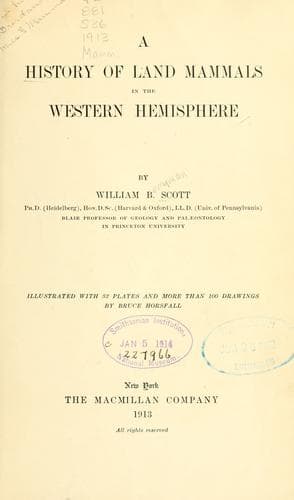
A history of land mammals in the western hemisphereScott, William Berryman
History
A history of land mammals in the western hemisphere
Scott, William Berryman
Mammals; Mammals, Fossil
The fauna of the Snake Creek formation in western Nebraska and that
of the presumably somewhat later beds of northwestern Nevada, which
are referable to the lower Pliocene, may be considered together. The
rodents, which are not very fully represented, were quite modern in
character and belonged mostly to extinct species of modern genera, such
as hares, pocket-gophers, beavers, forerunners of the †Giant Beaver,
marmots, sewellels, etc. A remnant of a more ancient world, especially
characteristic of the Miocene, is found in the remarkable burrowers,
the horned †mylagaulids which have been extinct since the lower
Pliocene. Carnivora were abundant, and members of all the families which
inhabit North America to-day have been obtained; wolves, “†bear-dogs,”
“†hyena-dogs” and forms like the Dhole of India were common. The terms
“†bear-dogs” and “†hyena-dogs” are not to be understood as implying any
relationships of these animals to bears or hyenas, but merely a certain
superficial resemblance; these were very large members of the dog family
(Canidæ), now extinct. Mustelines, large and small, are found, and
possibly some bears had already made their way from the Old World, but
this is still uncertain. †Sabre-tooth tigers and true cats, some as large
as lions and one species fairly gigantic, were likewise characteristic
of the time. There was a great wealth of horses, though the modern genus
_Equus_ was not among them; all the genera are now extinct and all were
three-toed. Several distinct phyla were represented, some progressive and
advancing toward the modern forms, others conservative and stationary.
Browsing horses with low-crowned teeth, grazing horses with prismatic,
cement-covered teeth, heavier and lighter, larger and smaller, must have
covered the plains and thronged the woods. Ancestral tapirs were present,
though far less common. A family which seems to be utterly exotic to
North America, that of the rhinoceroses, was present, and of these there
were three or four series, mostly without horns, or with a very small
horn on the tip of the snout. The extremely aberrant perissodactyls
(†Ancylopoda), in which the hoofs were converted into great claws,
perhaps persisted, but the evidence is not conclusive.
Public-domain text, read in full here on John Shaqi.
Reviews
Reviews
No reviews yet
Be the first to share your thoughts on this work.
Elsewhere in the archive
Join the Discussion
Join the discussion
Sign in to leave a comment or review.
Sign InorCreate an account