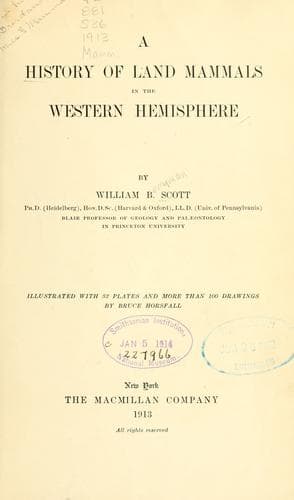
A history of land mammals in the western hemisphereScott, William Berryman
History
A history of land mammals in the western hemisphere
Scott, William Berryman
Mammals; Mammals, Fossil
The large number of genera, especially among the †toxodonts and
†typotheres, which had high-crowned, cement-covered teeth, may be taken
as an indication that grazing habits had already begun to be prevalent.
Of this wonderful assemblage of hoofed animals, divisible into six
separate groups, whether of ordinal or subordinal rank, not a trace
remains to-day. Not only are all the species, genera and families
extinct, but the suborders and orders also. Further, this was a very
strictly autochthonous fauna, so far as the hoofed animals were
concerned, and no member of any of the six groups has ever been found
outside of the Neotropical region.
4. _Eocene_
_North America._—In the western interior of North America the Oligocene
followed so gradually upon the Eocene, that there is great difficulty
in demarcating them and much difference of opinion and practice obtains
as to where the boundary line should be drawn. Not to depart too widely
from the scheme used by Professor Osborn, the Uinta stage is here
treated as uppermost Eocene, though this is a debatable procedure. For
several reasons, the extraordinarily interesting and significant Uinta
fauna is far less completely known than that of the preceding Bridger
and succeeding White River stages. For one thing, it has been much less
thoroughly explored, and it may be confidently expected that future
exploration will greatly enlarge our knowledge.
The smaller mammals of the Uinta are particularly ill-known. No
Insectivora have yet been found, though this gap will assuredly be
filled; rodents are scanty in the collections and include only two
families, one the †ischyromyids, which were still common in the
White River, the other of doubtful position, but not improbably to
be considered as the beginning of the pocket-gophers (Geomyidæ). The
archaic flesh-eaters, or †Creodonta, were represented by two families,
one comprising smaller animals with somewhat cat-like, shearing
teeth (†Oxyænidæ), the other, very large beasts with crushing teeth
(†Mesonychidæ), neither of which continued into the White River. As
compared with the middle and lower Eocene, the †creodonts had greatly
diminished and, to replace them, the true Carnivora were beginning to
come in. As yet, however, only small and very primitive dog-like forms
are known and no trace of †sabre-tooths or mustelines has been found.
Indeed, it is very doubtful whether members of these families ever will
be found in the Uinta, for their presence in the succeeding White River
was probably due to immigration.
Public-domain text, read in full here on John Shaqi.
Reviews
Reviews
No reviews yet
Be the first to share your thoughts on this work.
Elsewhere in the archive
Join the Discussion
Join the discussion
Sign in to leave a comment or review.
Sign InorCreate an account