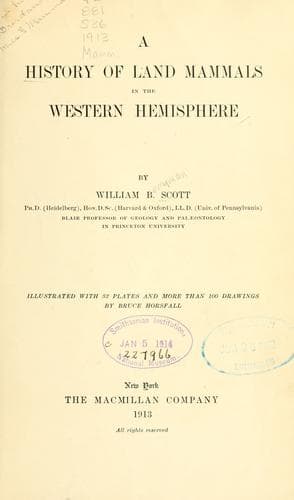
A history of land mammals in the western hemisphereScott, William Berryman
History
A history of land mammals in the western hemisphere
Scott, William Berryman
Mammals; Mammals, Fossil
Another immigrant order of great interest, since we ourselves belong
to it, the Primates, made its first appearance in North America in the
Wasatch, but was not destined to long life or great importance in this
continent, where it did not survive the Eocene. Several different kinds
of small, lemur-like and monkey-like creatures dwelt in the tree-tops
of the Wasatch forests. One genus (_†Anaptomorphus_) had a remarkable
likeness to the modern Tarsier (_Tarsius spectrum_) of the Malay
peninsula and islands.
_South America._—The Eocene of South America, referred by some writers to
the upper Cretaceous, is very incompletely and unsatisfactorily known.
The Casa Mayor formation (or Notostylops Beds), which has yielded a
great variety of mammals, for the most part very fragmentary, probably
contains not one but several successive faunas which have not yet been
fully discriminated, and that of the next succeeding Astraponotus Beds is
still but a scanty list. This list, however, includes the most ancient
†glyptodonts yet discovered and the most ancient †astrapotheres in the
narrow sense of the term. The Astraponotus Beds may be either Eocene or
Oligocene in date.
Taking the Casa Mayor faunas as a whole, they were a very numerous and
diversified assemblage of small mammals, without a single large one
among them. There were no monkeys or rodents; otherwise, the orders
were in almost all cases the same as those which made up the Santa Cruz
fauna. The marsupials were represented by the opossums and by several
of the carnivorous kinds, the only beasts of prey that South America
had until the migrations from the north brought in the true Carnivora,
late in the Miocene or very early in the Pliocene. There were also
numerous small marsupials of peculiar type, of which the last living
survivor is _Cænolestes_, of Ecuador. Throughout the stage, armadillos
were present in considerable variety, but are known only from the bony
plates of the carapace, and therefore little can be determined as to
their relationships to the modern families. Only a single and very
problematical genus of the †ground-sloths, which afterwards throve so
mightily in the Miocene and Pliocene, has been obtained and that in the
later portion of the stage.
Public-domain text, read in full here on John Shaqi.
Reviews
Reviews
No reviews yet
Be the first to share your thoughts on this work.
Elsewhere in the archive
Join the Discussion
Join the discussion
Sign in to leave a comment or review.
Sign InorCreate an account