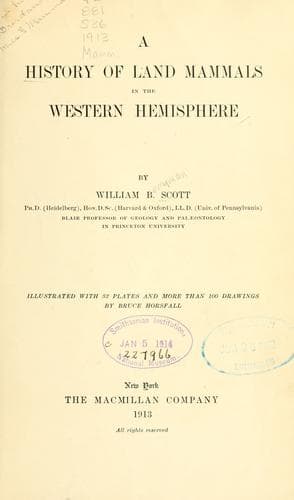
A history of land mammals in the western hemisphereScott, William Berryman
History
A history of land mammals in the western hemisphere
Scott, William Berryman
Mammals; Mammals, Fossil
_†Lambdotherium_, low. Eoc. _†Eotitanops_, low. Eoc.
_†Palæosyops_, mid. Eoc. _†Telmatherium_, mid. Eoc.
_†Dolichorhinus_, up. Eoc. _†Diplacodon_, up. Eoc.
_†Titanotherium_, low. Oligo.
III. TAPIRIDÆ. Tapirs.
_†Systemodon_, low. Eoc. _†Isectolophus_, mid. and
up. Eoc. _†Protapirus_, Oligo. _†Tapiravus_, mid.
Mioc. _Tapirus_, Pleist., N. Amer., Pleist. and
Recent, S. Amer.
IV. †LOPHIODONTIDÆ. †Lophiodonts.
_†Heptodon_, low. Eoc. _†Helaletes_, mid. Eoc.
_†Colodon_, low. Oligo.
V. RHINOCEROTIDÆ. True Rhinoceroses.
_†Trigonias_, low. Oligo. _†Cænopus_, Oligo. and low.
Mioc. _†Diceratherium_, up. Oligo. and low. Mioc.
_†Aphelops_, mid. Mioc. to low. Plioc. _†Teleoceras_,
mid. Mioc. to low. Plioc.
VI. †HYRACODONTIDÆ. †Hyracodonts and †Amynodonts, cursorial and
aquatic Rhinoceroses.
_†Hyrachyus_, low. and mid. Eoc. _†Triplopus_, mid.
and up. Eoc. _†Colonoceras_, mid. Eoc. _†Hyracodon_,
low. Oligo. _†Amynodon_, up. Eoc. _†Metamynodon_,
low. Oligo.
Suborder †ANCYLOPODA. †Clawed Perissodactyls
VII. †CHALICOTHERIIDÆ. Chalicotheres.
_†Moropus_, up. Oligo. and low. Mioc.
_?†Schizotherium_, low. Oligo. _†Eomoropus_, mid. Eoc.
The earliest perissodactyls of which we have any knowledge are found in
the older part of the lower Eocene (Wasatch stage) of Europe and North
America, into which they must have migrated from some other region
yet unknown, for no probable ancestors of the group are found in the
Paleocene of either continent.
I. SUBORDER CHELODACTYLA. NORMAL PERISSODACTYLA.
1. _Equidæ. Horses_
In order to make intelligible the evolutionary changes which have led up
to the modern horses, it will be necessary to say something concerning
the dental and skeletal features which characterize these animals. Using
the term _horses_ in a broad sense to include all the existing members
of the family Equidæ, true horses, asses, zebras and quaggas, we find a
greater uniformity in the skeleton and teeth than would be expected from
the external appearance. The differences in appearance are, however,
largely due to colouring, growth of mane and tail and the size of the
ears, which leave no record in the skeleton.
[Illustration: FIG. 147.—Asiatic Wild Horse (_Equus przewalskii_).—By
permission of the N.Y. Zoölog. Soc.]
The teeth (Figs. 45, p. 95; 154, p. 306) are extremely high-crowned,
or hypsodont, and do not form roots till an advanced age; the incisors
have a deep, enamel-lined pit, the “mark” in the centre of the grinding
surface; the first premolar in each jaw is very small and of no
functional importance; the other premolars have the same pattern as the
molars, which is excessively complex in the arrangement of the enamel
ridges and the areas of dentine and cement.
Public-domain text, read in full here on John Shaqi.
Reviews
Reviews
No reviews yet
Be the first to share your thoughts on this work.
Elsewhere in the archive
Join the Discussion
Join the discussion
Sign in to leave a comment or review.
Sign InorCreate an account