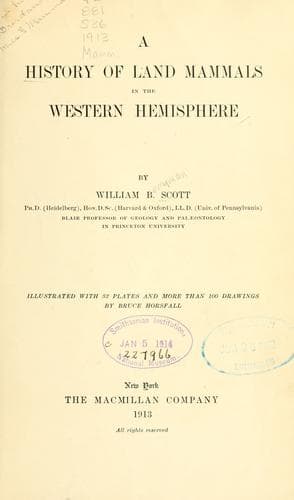
A history of land mammals in the western hemisphereScott, William Berryman
History
A history of land mammals in the western hemisphere
Scott, William Berryman
Mammals; Mammals, Fossil
Passing over, for lack of space, the transitional forms of the Wind
River, we come finally to the most ancient known horses, the Wasatch
species comprised in the genus _†Eohippus_, the “Dawn Horse,” as its name
signifies; these were little creatures ranging in size from a cat to a
small fox. Despite an unmistakably equine look in the skeletons of these
diminutive animals, it is only the long intermediate series of species
and genera, together forming a closely linked chain, which we have traced
back from the Pleistocene to the lower Eocene, that leads us to regard
_†Eohippus_ as the ancestral type of the horses. Were only the two ends
of the chain known, he would be a daring speculator who should venture
to connect them. In these little Wasatch horses we have the evidence of
a still more ancient form with five fully developed toes in each foot,
since the front foot had four functional digits and indication of a
splint, and splints, as the whole history of the long series teaches,
always are found to be functional digits in the ancestor; the hind foot
had three toes and perhaps two splints. This preceding form is hardly to
be looked for in America or Europe; it will be found, if ever, in the
region whence the great migration came. In all other respects, as well,
_†Eohippus_ was what we should expect the forerunner of the Wind River
and Bridger horses to be. The premolars were all smaller and simpler than
the molars and the latter in the upper jaw are particularly interesting,
for they had no crests and ridges of enamel, but four principal conical
cusps, arranged in two transverse pairs, and between the cusps of each
pair was a tiny cuspule no bigger than the head of a pin. These cuspules
were the first step in the formation of the transverse crests, which
were destined to assume such importance in the subsequent members of the
series. The neck was very short, the body long, with curved or arched
back, the limbs and feet short, and the hind limb much longer than
the fore, making the relative proportions of the various parts of the
skeleton very different from what they afterwards became.
Reviewing this marvellous history of steady and long-continued change,
beginning with the most ancient genus, _†Eohippus_, the following
modifications may be noted:
(1) There was a nearly constant, if somewhat fluctuating, increase in
size, leading by slow gradations from the diminutive horses of the lower
Eocene to the great animals of the Pleistocene.
Public-domain text, read in full here on John Shaqi.
Reviews
Reviews
No reviews yet
Be the first to share your thoughts on this work.
Elsewhere in the archive
Join the Discussion
Join the discussion
Sign in to leave a comment or review.
Sign InorCreate an account