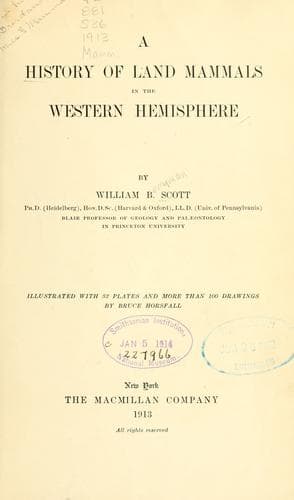
A history of land mammals in the western hemisphereScott, William Berryman
History
A history of land mammals in the western hemisphere
Scott, William Berryman
Mammals; Mammals, Fossil
The skull had a straight upper profile, though in several of the phyla
small bony protuberances were developed over the eyes, and must clearly
be regarded as incipient stages of the “horns” which were subsequently
to become so long and prominent. Instead of being broad on top as it
was in the White River genera, the cranium carried a high ridge of
bone, the sagittal crest, which served for the attachment on each side
of the great temporal muscle, one of the most important of the muscles
of mastication. The trunk was less massive and the limbs were lighter
than in the Oligocene genera, but the number of digits was the same,
four in the front foot and three in the hind, and the hoofs were much
better developed, serving actually to carry the weight and not being
mere excrescences upon the periphery of a pad. Aside from the proboscis,
which lends such a characteristic appearance to the existing tapirs, the
†titanotheres of the Bridger must have looked much like tapirs, and in
early days, when the mutual relationships had not been satisfactorily
determined, they were frequently described as “tapiroid.” The term is
unobjectionable in so far as it is understood that a merely superficial
likeness is implied, not any real relationship other than that which
unites all the perissodactyl families.
As noted above, the phyla of the †titanotheres were much more numerous
in the later than in the earlier part of the Bridger stage, when they
were reduced to two. In the still older Wind River stage these two united
into one. The Wind River animals (_†Eotitanops_) were similar, but much
smaller, and occurred in incomparably less variety and abundance. Indeed,
one of the most striking differences between the Wind River and the
Bridger faunas consists in the great increase and diversification of the
†titanotheres in the latter. There was, it is true, a second phylum of
the family in the Wind River, represented by the genus _†Lambdotherium_,
but this was a short-lived series, which left no descendants in the
Bridger or subsequent formations. These were the smallest known members
of the family and were light, slender-limbed animals, a very notable
difference from the others.
With the Wind River the history of the †titanotheres breaks off short,
and from present information, can be carried no farther back. Possibly,
there was a Wasatch ancestor, which only awaits discovery, but it seems
more likely that these earliest known genera were belated immigrants
from the same as yet unknown region, whence came the modernized and
progressive elements of the Wasatch fauna. Except for its obscure
beginning, the family was pre-eminently characteristic of North America,
and only two representatives of it have been found outside of that
continent, one in Hungary and one in Bulgaria. No doubt others will yet
be found in Asia.
Public-domain text, read in full here on John Shaqi.
Reviews
Reviews
No reviews yet
Be the first to share your thoughts on this work.
Elsewhere in the archive
Join the Discussion
Join the discussion
Sign in to leave a comment or review.
Sign InorCreate an account