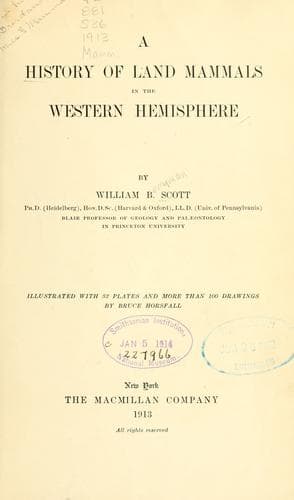
A history of land mammals in the western hemisphereScott, William Berryman
History
A history of land mammals in the western hemisphere
Scott, William Berryman
Mammals; Mammals, Fossil
There are considerable differences in proportions and general appearance
among the various species, but they all have short necks, very long
and massive bodies, short and heavy limbs and short, columnar feet,
which look much like those of elephants, but have only three toes
each. In all but two of the living species the upper lip is prehensile
and characteristically pointed and can be used to pick up very small
objects, like the “finger” on an elephant’s trunk; in the Sumatran
species (_Dicerorhinus sumatrensis_) the lip, though pointed, is
horny and inflexible, while in the African _O. simus_ it is broad and
straight-edged.
The teeth of the modern rhinoceroses are extremely characteristic and
may always be recognized at a glance. In the African genus (_Opsiceros_)
there are no front teeth, all the incisors and canines being lost;
the other genera have on each side a single large and trenchant upper
incisor, in shape like a broad, obliquely edged chisel, which shears
against a still larger elongate and tusk-like lower incisor, that is
procumbent and points directly forward. The Indian Rhinoceros (_R.
unicornis_) is said to use its tusks as weapons in very much the same
fashion as the Wild Boar. Between the large lower tusks there is a pair
of very small incisors, which can have little or no functional value;
the third lower incisor has been suppressed, as have also the canines
of both jaws. The dental formula then is: _i_ 1/2 or 0/0, _c_ 0/0, _p_
4/4, _m_ 3/3, × 2 = 28 or 34 (see p. 93). The premolars, except the
first, though somewhat smaller than the molars, have essentially the same
pattern. The upper molars have moderately high crowns, yet they are
purely brachyodont, except in the grazing, broad-lipped African species
(_O. simus_), in which they may fairly be called hypsodont. The external
wall of the tooth is broad and nearly smooth, not divided into cusps,
as it is in the horses and tapirs, and the two transverse crests, which
in the tapirs are directly transverse, are very oblique. In all the
existing species additional complications are given by the short spurs,
which project inward from the outer wall or from the transverse crests.
The lower molars are formed each of two crescents, one behind the other,
but their arms or horns are angulate, not curved as they are in other
perissodactyls which have crescentic lower teeth.
Public-domain text, read in full here on John Shaqi.
Reviews
Reviews
No reviews yet
Be the first to share your thoughts on this work.
Elsewhere in the archive
Join the Discussion
Join the discussion
Sign in to leave a comment or review.
Sign InorCreate an account