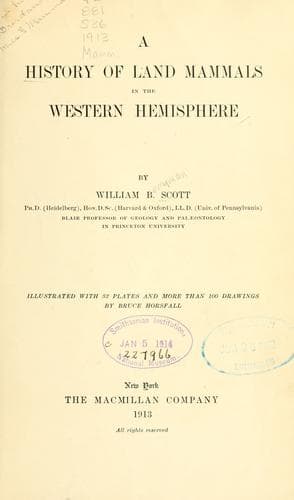
A history of land mammals in the western hemisphereScott, William Berryman
History
A history of land mammals in the western hemisphere
Scott, William Berryman
Mammals; Mammals, Fossil
The specimens which so far have been found in the American middle and
upper Miocene and lower Pliocene are very fragmentary, consisting of
little more than teeth, and give no information other than to demonstrate
the presence of the family in North America during that period of time.
On the other hand, the European genera of the middle Miocene and lower
Pliocene are well known and may or may not have been closely similar
to their American contemporaries, though they were undoubtedly larger.
In these most peculiar and grotesque animals (_†Macrotherium_ and
_†Chalicotherium_) the head was relatively small, the teeth were very
low-crowned and adapted only to a diet of soft vegetable substances
and the mode of feeding must have been that of browsing upon leaves
and shoots of trees and bushes; the premolars had not acquired the
molar-pattern, which was very exceptional for perissodactyls of so
late a time, such a difference between the two classes of teeth being
characteristic of the Eocene members of the order; the incisors and
canines were reduced, but the formula is not definitely known.
The neck was of moderate length, the body very long, and the limbs were
also elongate, especially the anterior pair, in consequence of which the
back sloped downward from the shoulders to the rump; the two fore-arm
bones were fused together, and these, with the thigh-bones, were the
longest segments of the limbs. The special peculiarity of these animals
was in the character of the feet, which had three toes, each armed with
a huge claw, instead of terminating in a hoof, as it does in all normal
perissodactyls. The external digit, which, in the absence of the fifth,
was the fourth, was the largest of the series and apparently bore the
most of the weight, a notable departure from the normal perissodactyl
symmetry, in which the third or median toe is the largest. The hind feet
were considerably smaller than the fore, but had similar claws.
Public-domain text, read in full here on John Shaqi.
Reviews
Reviews
No reviews yet
Be the first to share your thoughts on this work.
Elsewhere in the archive
Join the Discussion
Join the discussion
Sign in to leave a comment or review.
Sign InorCreate an account