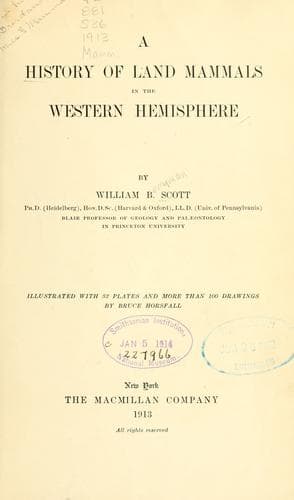
A history of land mammals in the western hemisphereScott, William Berryman
History
A history of land mammals in the western hemisphere
Scott, William Berryman
Mammals; Mammals, Fossil
The Prong Buck, or Prong-horned Antelope (_Antilocapra americana_),
occupies a very isolated position, so much so that a distinct family,
the Antilocapridæ, has been created for its reception. It differs from
all other Cavicornia in having a branched horn, though the bony core
is simple, and in annually shedding and renewing the horny sheath; the
horn is directly over the eye; there are no dew-claws and all traces
of the bones of the lateral digits have completely disappeared. The
grinding teeth are thoroughly hypsodont. The genus occurred in the older
Pleistocene, where it was associated with the last of the †deer-antelope,
or _†Merycodus_ series (_†Capromeryx_), and which, so far as it is known,
would seem to connect the two families, though this is doubtful. A middle
Miocene genus (_†Dromomeryx_ Fig. 128, p. 237) would be a more probable
ancestor of the Prong Buck, if it were not for the long, unfilled gap
of the upper Miocene and the whole Pliocene. _†Dromomeryx_ had erect
horn-cores placed directly above the eyes as in the modern genus, but
low-crowned grinding teeth; it was the most ancient American cavicorn
yet known. It remains to be determined by future exploration, whether
this middle Miocene genus was actually the ancestor of _Antilocapra_, or
merely an anticipation of it.
In the lower Pliocene have been found the remains, very incomplete, of
several antelopes, which appear to have been immigrants from the Old
World, but are too imperfectly known for any definitive reference. One
resembles the flat-horned, or goat-horned, antelopes of the European
Miocene and Pliocene. Others had spirally twisted horns like those of the
Recent strepsicerine, or twisted-horn antelopes of Africa and Asia, but
may, nevertheless, be referable to the Antilocapridæ.
Antelopes even penetrated to South America, and three genera of them
have been reported from the Pleistocene of the Brazilian caverns and
the Argentine pampas, but they were less successful in establishing a
foothold than were the deer, and form no part of the modern Neotropical
fauna.
11. _Bovidæ. Sheep, Bisons, Oxen, etc._
A series of genera, of disputed systematic position, is represented
to-day by the so-called Musk-Ox (_Ovibos moschatus_), which is now
exclusively North American, but in the Pleistocene ranged over northern
Asia and Europe as far west as Great Britain. The Musk-Ox, which is at
present found only in the extreme north, is a heavy, short-legged animal,
three and a half to four feet high, and six feet or more in length; the
body is covered with a dense coat of woolly hair overlaid by a thatch of
long, straight hair, which gives the animal a very shaggy appearance.
The horns are broad at the base, especially so in old males, in which
they meet in the middle line and cover much of the head as with a horny
casque; they curve downward and then upward and forward, with the tips
directed toward the front; in the females and young males the horns are
very much smaller.
Public-domain text, read in full here on John Shaqi.
Reviews
Reviews
No reviews yet
Be the first to share your thoughts on this work.
Elsewhere in the archive
Join the Discussion
Join the discussion
Sign in to leave a comment or review.
Sign InorCreate an account