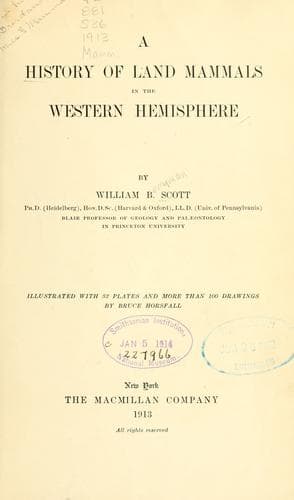
A history of land mammals in the western hemisphereScott, William Berryman
History
A history of land mammals in the western hemisphere
Scott, William Berryman
Mammals; Mammals, Fossil
The suborder Pecora at an early date became divided into the two great
branches of the Cervicornia and Cavicornia, the former giving off the
giraffe series, which in the Miocene and Pliocene ramified and extended
through Asia and southern Europe, though now confined to Africa. In
the lower Miocene of Europe the muntjac-like deer and the antelopes,
the first of the Cavicornia, were already well distinguished. From
the primitive antelopes arose not only the wonderful assemblage of
modern antelopes, but also the goats and sheep and the great and varied
ox-tribe. From the middle Oligocene forms it may obviously be inferred
that both Cervicornia and Cavicornia united in a single trunk, or, traced
in the other direction, diverged from a common stock, to which also the
suborder of the Tragulina goes back.
On the other hand, it is equally obvious that the camels and llamas have
been separated from the Pecora at least since the middle Eocene, and,
consequently, the many points of agreement between the two suborders,
other than those shared with all artiodactyls, are not due to inheritance
from a common ancestry, but have been independently acquired in the
two series. It will be instructive to note some of the more important
of these independent similarities: (1) the selenodont and more or
less hypsodont character of the grinding teeth; (2) the spout-shaped
odontoid process of the axis; (3) the great reduction of the ulna and
its coössification with the radius; (4) the loss of the fibula, except
for its lower end, which persists as a separate malleolar bone; (5)
the formation of cannon-bones by the fusion of the third and fourth
metapodials; (6) the development of a complex, many-chambered stomach.
Other points of likeness might be cited, but those already given will
suffice to show how very important this parallel mode of evolution often
proves itself to be.
CHAPTER X
HISTORY OF THE PROBOSCIDEA
Utterly foreign as the elephant-tribe appears to be to present-day North
America, it was a very conspicuous element in the fauna of that continent
from the middle Miocene to the end of the Pleistocene, and in the latter
epoch it spread over South America also. Like so many others of the
mammals which have, from time to time, flourished in the Americas, the
elephants and their allies, the †mastodons, were immigrants from the
Old World, and, until comparatively lately, the region of their origin
was a complete mystery. They appeared suddenly and unheralded and at
approximately the same time in Europe and North America and nothing is
known from preceding geological formations of either continent which
could with any plausibility be regarded as ancestral to them. The mystery
was dispelled by the discoveries of Dr. C. W. Andrews in Egypt, which
demonstrated that these strange and huge beasts had originated in Africa
and had migrated thence through Asia to Europe, on the one side, and to
North America on the other.
Public-domain text, read in full here on John Shaqi.
Reviews
Reviews
No reviews yet
Be the first to share your thoughts on this work.
Elsewhere in the archive
Join the Discussion
Join the discussion
Sign in to leave a comment or review.
Sign InorCreate an account