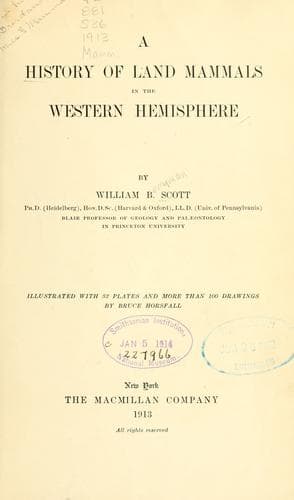
A history of land mammals in the western hemisphereScott, William Berryman
History
A history of land mammals in the western hemisphere
Scott, William Berryman
Mammals; Mammals, Fossil
The system of zoölogical classification which is still in use was
largely the invention of the Swedish naturalist Linnæus, who published
it shortly after the middle of the eighteenth century. As devised by
Linnæus, the scheme was intended to express ideal relationships, whereas
now it is employed to express real genetic affinities, so far as these
can be ascertained. The Linnæan system is an organized hierarchy of
groups, arranged in ascending order of comprehensiveness. In this scheme,
what may be regarded as the unit is the _species_, a concept around
which many battles have been waged and concerning which there is still
much difference of opinion and usage. Originally a term in logic, it
first received a definite meaning in Zoölogy and Botany from John Ray
(1628-1705) who applied it to indicate a group of animals, or plants,
with marked common characters and freely interbreeding. Linnæus, though
not always consistent in his expressions on the subject, regarded species
as objective realities, concrete and actual things, which it was the
naturalist’s business to discover and name, and held that they were fixed
entities which had been separately created. This belief in the fixity
and objective reality of species was almost universally held, until
the publication of Darwin’s “Origin of Species” (1859) converted the
biological world to the evolutionary faith, which declares that the only
objective reality among living things is the individual animal or plant.
According to this modern conception, a species may be defined as
signifying a “grade or rank assigned by systematists to an assemblage of
organic forms which they judge to be more closely interrelated by common
descent than they are related to forms judged to be outside the species”
(P. Chalmers Mitchell). The technical name of a species, which is either
in Latin, or in latinized form, is in two words, one of which designates
the genus (see below) and the other the particular species of that genus,
as, for example, _Equus caballus_, the species Horse, _E. przewalskii_,
the Asiatic Wild Horse, _E. asinus_, the species Ass, etc. In order to
identify a species, the genus to which it belongs must be stated, hence
the term, _binomial system_ of nomenclature, which Linnæus introduced,
becoming _trinomial_ when the name of a subspecies is added, a modern
refinement on the older method. A very large species (_i.e._ one which
is represented by great numbers of individuals), extending over a very
large area, is often divisible into groups of minor rank, as _varieties_,
_geographical races_ or _subspecies_. Taking the species as the unit
in the scheme of classification, the varieties and subspecies may be
considered as fractions.
Public-domain text, read in full here on John Shaqi.
Reviews
Reviews
No reviews yet
Be the first to share your thoughts on this work.
Join the Discussion
Join the discussion
Sign in to leave a comment or review.
Sign InorCreate an account