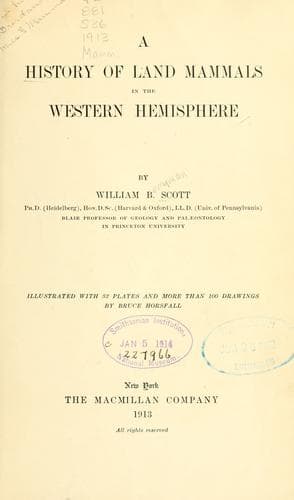
A history of land mammals in the western hemisphereScott, William Berryman
History
A history of land mammals in the western hemisphere
Scott, William Berryman
Mammals; Mammals, Fossil
The Paleocene formations of the western interior are of non-marine or
continental origin. In northwestern New Mexico is the typical area
of the _Puerco_ and _Torrejon_, a series of beds 800 to 1000 feet in
thickness and for the most part quite barren of fossils, but there are
two horizons, one near the top and the other near the bottom of the
series, which have yielded a very considerable number of fossil mammals,
and of these the lower is the Puerco, the upper the Torrejon. The _Fort
Union_ is quite different in character and is composed of great areas
of sandstone and clay rocks, with a maximum thickness of 2000 feet,
in eastern Wyoming, South Dakota, Montana and the adjoining parts of
Canada. The modes of formation of these beds have not yet been fully
determined; that they may have been partly laid down in shallow lakes is
indicated by the masses of fresh-water shells in certain localities. In
others are preserved multitudes of leaves, which have given a very full
conception of the plants of the time, and great swamps and bogs have left
the traces of their presence in beds of lignite, or imperfectly formed
coal. Deposits made on the flood-plains of rivers and wind accumulations
are probably also represented. “Vast stretches of subtropical and more
hardy trees were interspersed with swamps where the vegetation was rank
and accumulated rapidly enough to form great beds of lignite. Here were
bogs in which bog iron was formed. Amid the glades of these forests
there wandered swamp turtles, alligators, and large lizards of the
characteristic genus _Champsosaurus_” (Osborn, p. 100).
Fort Union mammals are relatively rare and most of those that have been
found are very fragmentary; they are amply sufficient, however, to
demonstrate the Paleocene date of the beds and to make it probable that
they include both the Puerco and the Torrejon faunas.
The climate, as shown by the plants, was much milder and more uniform
than that of the Recent epoch, though some indication of climatic zones
may already be noted. The vegetation was essentially modern in character;
nearly all our modern types of forest-trees, such as willows, poplars,
sycamores, oaks, elms, maples, walnuts and many others, were abundantly
represented in the vast forests which would seem to have covered nearly
the entire continent from ocean to ocean and extended north into Alaska
and Greenland, where no such vegetation is possible under present
conditions. Numerous conifers were mingled with the deciduous trees,
but we do not find exclusively coniferous forests. Palms, though not
extending into Greenland, flourished magnificently far to the north of
their present range. On the other hand, the Paleocene flora of England
points to a merely temperate climate, while that of the succeeding Eocene
was subtropical.
Public-domain text, read in full here on John Shaqi.
Reviews
Reviews
No reviews yet
Be the first to share your thoughts on this work.
Elsewhere in the archive
Join the Discussion
Join the discussion
Sign in to leave a comment or review.
Sign InorCreate an account