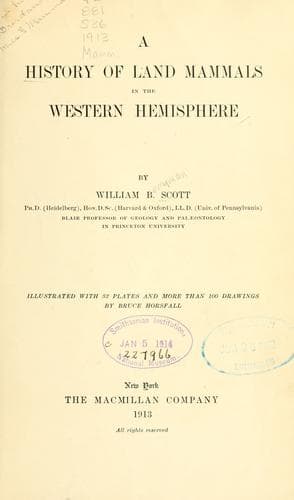
A history of land mammals in the western hemisphereScott, William Berryman
History
A history of land mammals in the western hemisphere
Scott, William Berryman
Mammals; Mammals, Fossil
a very great length of time, geologically speaking, for the degree of
development involved. This is the earliest recorded one of the great
waves of mammalian migration which invaded North America down almost to
our own time.
The same wave of migration extended to Europe, and that there was a broad
and easy way of communication between that continent and North America
is plain, for the similarity between the Wasatch mammals and those of
the corresponding formation in France, the _Sparnacian_, is remarkably
close. At no subsequent time were the mammalian faunas of North America
and Europe so nearly identical as during the Wasatch-Sparnacian age,
which is especially remarkable when the discrepancy is noted between the
vast stretches of the Wasatch (150,000 square miles) and the very limited
areas in France.
If, as is probable, the Ural Sea was in existence at that time, the
land-connection with Europe must have been across the North Atlantic,
most likely from Greenland eastward. At the present time a land-bridge
in such high latitudes would be of little service in bringing about a
similarity of mammals in the two continents, for the severity of the
Arctic climate would be as effective a barrier against the intermigration
of all save the Arctic mammals as the ocean itself; but in the mild and
genial Eocene climate the latitude of the bridge was of small consequence.
The second of the Eocene stages, the _Wind River—Green River_, is found
in two very different phases. The Wind River phase occupies the basin
of that stream, north of the Wind River Mountains in central Wyoming,
and in the Big Horn Basin of the same state it very extensively overlies
the Wasatch, and in this phase the sediments are very like those of the
latter, flood-plain and wind accumulations. A widely distant area of
this stage occurs in the Huerfano Cañon in Colorado. The Wind River beds
contain numerous mammals which were clearly sequential to those of the
Wasatch, of which they were the more or less modified descendants. With
two possible exceptions, there were no new immigrants and the connection
with the Old World may have been already severed, as it assuredly was in
the succeeding age, the Bridger, though divergent development had not yet
had time to produce the very striking differences in the mammals of North
America from those of Europe, which characterized the Bridger.
The Green River phase is a thick body of finely laminated “paper shales,”
which seem to have been deposited in a very shallow lake and occupy
some 5000 square miles of the Green River valley in southern Wyoming
and northern Utah, where they overlie the Wasatch, just as do the Wind
River beds in the Big Horn Basin. These fine-grained and thinly laminated
shales have preserved, often in beautiful perfection, countless remains
of plants, insects and fishes, but no traces of mammals, other than
footprints, have been found.
Public-domain text, read in full here on John Shaqi.
Reviews
Reviews
No reviews yet
Be the first to share your thoughts on this work.
Elsewhere in the archive
Join the Discussion
Join the discussion
Sign in to leave a comment or review.
Sign InorCreate an account