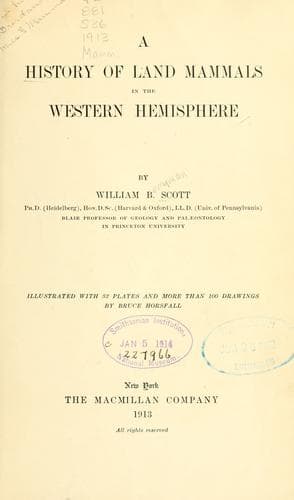
A history of land mammals in the western hemisphereScott, William Berryman
History
A history of land mammals in the western hemisphere
Scott, William Berryman
Mammals; Mammals, Fossil
The Eocene climate was decidedly warmer than the present one, and
subtropical conditions extended over the whole United States and perhaps
far into Canada. On the other hand, signs of increasing aridity in
the western part of the continent are not wanting, and that must have
resulted in a great shrinkage of the forests and increase of the open
plains. The vegetation was essentially the same as in the Paleocene, when
it had already attained a modern character, the differences from the
present being chiefly in regard to geographical distribution. Large palms
were then flourishing in Wyoming and Idaho, and another indication of a
warm climate is furnished by the large crocodiles which abounded in all
of the Eocene stages.
So far as North America was concerned, the Eocene epoch was brought to
a close by extensive movements of the earth’s crust, which more or less
affected the entire continent and were registered both on the sea-coasts
and in the mountain ranges of the interior. Upheaval added a narrow belt
of land along the Atlantic and Gulf coasts and the Mississippi Embayment
was nearly closed. On the Pacific side the sea withdrew from the great
valley of California and Oregon, and in the interior the plateau region
was elevated by a great disturbance, which also increased the height of
the western mountains.
Our knowledge of Eocene land-mammals in North America is almost wholly
derived from the formations of the western United States, but it may
be inferred from the uniform climatic conditions that there were no
very great geographical differences among the animals. This inference
is confirmed by the discovery of a Bridger genus, very fragmentary but
identifiable, in the marine Eocene of New Jersey.
Public-domain text, read in full here on John Shaqi.
Reviews
Reviews
No reviews yet
Be the first to share your thoughts on this work.
Elsewhere in the archive
Join the Discussion
Join the discussion
Sign in to leave a comment or review.
Sign InorCreate an account