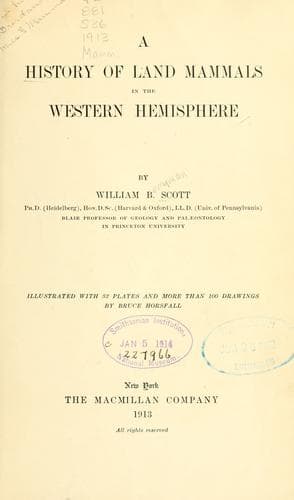
A history of land mammals in the western hemisphereScott, William Berryman
History
A history of land mammals in the western hemisphere
Scott, William Berryman
Mammals; Mammals, Fossil
_South America._—In Central America, where marine Oligocene beds are
of great extent, no Miocene is known, and on the Isthmus Oligocene is
the latest marine formation, except a narrow fringe of Pleistocene
on the Caribbean coast. These facts and others already cited lead to
the conclusion that in the Miocene the connection of the Americas was
complete and that the Isthmus was considerably broader than at present,
extending nearly to Jamaica. The condition of the Greater Antilles is but
vaguely understood, but they were involved in the general elevation of
the Caribbean region and were at least as large as they are now and may
have been considerably larger, and Cuba was perhaps joined to Central
America, as Hayti probably was.
In South America proper nearly the whole of Patagonia was submerged
by the transgression of a shallow, epicontinental sea, in which were
accumulated the beds of the _Patagonian_ stage, containing an exceedingly
rich and varied assemblage of marine fossils, an assemblage which has
very little in common with the contemporary formations of the northern
hemisphere. It is this lack of elements common to the northern faunas
which has led to the long debate concerning the geological date of the
Patagonian formation, the South American geologists very generally
referring it to the Eocene. However, the occurrence of genera of
Cetaceans (whales and dolphins), which are also found in the Miocene
of Maryland and Virginia, is very strong evidence that the proper date
of the Patagonian is Miocene. A continuous coast-line, or at least an
unbroken continuity of shoal-water conditions, seems necessary to account
for the similarity of the Patagonian fossils with those of New Zealand
and Australia, and that this connection was by way of the Antarctic
continent is indicated by the occurrence of similar fossils in the South
Shetland Islands, an Antarctic group. On the Chilian coast the _Navidad_
formation, which is believed to be approximately contemporaneous with
the Patagonian, has so different a fauna as to point to some kind of a
barrier between the Atlantic and the Pacific, and this barrier, Dr. von
Ihering holds, was the land-extension from South America to Antarctica.
Public-domain text, read in full here on John Shaqi.
Reviews
Reviews
No reviews yet
Be the first to share your thoughts on this work.
Elsewhere in the archive
Join the Discussion
Join the discussion
Sign in to leave a comment or review.
Sign InorCreate an account