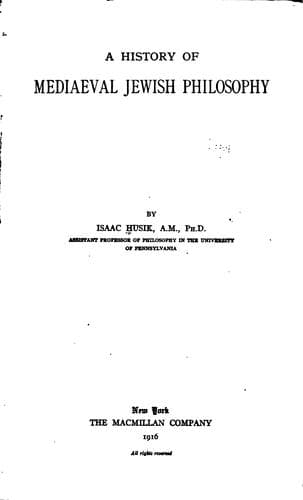
A History of Mediaeval Jewish PhilosophyHusik, Isaac
ReligionJewish
A History of Mediaeval Jewish Philosophy
Husik, Isaac
Philosophy, Jewish; Philosophy, Medieval
corporeal world at the other. Intermediate between these are the
spiritual substances, Intelligence, Soul and Nature.[94] Man as a
microcosm, a universe in little, partakes of both the corporeal and
intermediate worlds, and hence may serve as a model of the constitution
of the macrocosm, or great universe. His body is typical of the
corporeal world, which consists of the lowest matter, viz., that which
has no other form except that of corporeality, or extension, and the
forms of figure, color, and so on, borne on top of the extension.[95]
Body as such is at rest and is not capable of action. To act it needs an
agent. Hence it needs an agency to compose its parts and hold them
together. We call this agency Nature. Man's body also grows, is
nourished and propagates its kind as do plants. This likewise must have
its non-corporeal cause. This we call vegetative soul. Man has also
sense perception and local motion like the animals. The principle or
substance causing this is the animal soul. Man also thinks and reasons
and reflects. This is brought about by the rational soul. Finally, man
has a still higher function than discursive thought. The latter has to
search and to pass from premise to conclusion, whereas the apprehension
of the intelligence takes place "without seeking, without effort, and
without any other cause except its own essence, because it is full of
perfection." In other words, it is immediate intellectual intuition of
which Gabirol speaks here. The Intelligence is capable of this because
it has in itself, constituting its essence, all the forms of existence,
and knowledge means possession of the forms of the things known.
As man is typical of the universe, it follows that there are cosmic
existences corresponding to the principles or powers just enumerated in
man, and the relation of the latter to the former is that of the
particular to the general. Hence there is a cosmic Intelligence, a
cosmic soul embracing the rational, the animal and the vegetative parts,
and a cosmic nature. Of these the more perfect is the cause of the less
perfect; hence the order in which we named them represents the order of
causation or of emanation from the prime source.
Public-domain text, read in full here on John Shaqi.
Reviews
Reviews
No reviews yet
Be the first to share your thoughts on this work.
Elsewhere in the archive
Join the Discussion
Join the discussion
Sign in to leave a comment or review.
Sign InorCreate an account