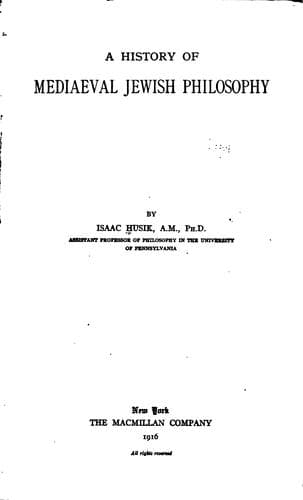
A History of Mediaeval Jewish PhilosophyHusik, Isaac
ReligionJewish
A History of Mediaeval Jewish Philosophy
Husik, Isaac
Philosophy, Jewish; Philosophy, Medieval
Besides, plurality is an attribute of substance, and belongs to the
category of quantity. But the creator is neither substance nor accident
(attribute), hence plurality cannot pertain to him. But if he cannot be
described as multiple, he must be one.
If the creator is more than one, it follows that either each one of them
could create the world alone, or he could not except with the help of
the other. If we adopt the first alternative, there is no need of more
than one creator. If we adopt the second, it follows that the creator is
limited in his power, hence, as above, composite, and not eternal, which
is impossible. Besides, if there were more than one creator, it is
possible that a dispute might arise between them in reference to the
creation. But all this time no such thing has happened, nature being
always the same. Hence God is one. Aristotle also agrees with us, for he
applies in this connection the Homeric expression, "It is not good to
have many rulers, let the ruler be one" (Iliad, II, 204; Arist.,
Metaphysics, XII, ch. 10, p. 1076a 4).[115]
So far as Bahya proves the unity of God he does not go beyond Saadia,
some of whose arguments are reproduced by him, and one or two of a
Neo-Platonic character added besides. But there is a decided advance in
the analysis which follows, in which Bahya shows that there are various
kinds of unity in our experience, and that the unity of God is unique.
We apply the term one to a class, a genus, a species, or an individual.
In all of these the multiplicity of parts is visible. The genus animal
contains many animals; the species man embraces a great many individual
men; and the individual man consists of many parts and organs and
faculties. Things of this sort are one in a sense and many in a sense.
We also apply the term one to an object in which the multiplicity of
parts is not as readily visible as in the previous case. Take for
example a body of water which is homogeneous throughout and one part is
like another. This too is in reality composed of parts, matter and form,
substance and accident. It is in virtue of this composition that it is
subject to genesis and decay, composition and division, union and
separation, motion and change. But all this implies plurality. Hence in
both the above cases the unity is not essential but accidental. It is
because of a certain appearance or similarity that we call a thing or a
class one, which is in reality many.
Another application of the term one is when we designate by it the basis
of number, the numerical one. This is a true one, essential as
distinguished from the accidental referred to above. But it is mental
and not actual. It is a symbol of a beginning which has no other before
it.
Public-domain text, read in full here on John Shaqi.
Reviews
Reviews
No reviews yet
Be the first to share your thoughts on this work.
Elsewhere in the archive
Join the Discussion
Join the discussion
Sign in to leave a comment or review.
Sign InorCreate an account