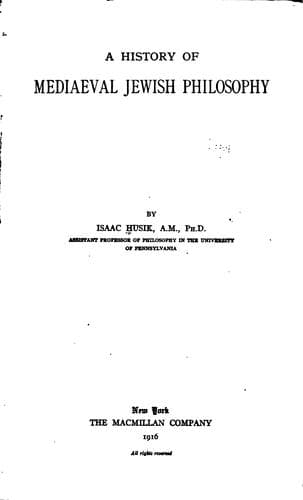
A History of Mediaeval Jewish PhilosophyHusik, Isaac
ReligionJewish
A History of Mediaeval Jewish Philosophy
Husik, Isaac
Philosophy, Jewish; Philosophy, Medieval
Self-examination is conducive to repentance. By this term is meant
taking stock of one's spiritual condition so as to know the merits one
has as well the duties one owes. In order to do this conscientiously a
man must reflect on the unity of God, on his wisdom and goodness, on the
obedience which all nature pays to the laws imposed upon it, disregard
of which would result in the annihilation of all things, including
himself. A man should review his past conduct, and provide for his
future life, as one provides for a long journey, bearing in mind that
life is short, and that he is a stranger in this world with no one to
help him except the goodness and grace of his maker. He should cultivate
the habit of being alone and not seek the society of idlers, for that
leads to gossip and slander, to sin and wrong, to vanity and neglect of
God. This does not apply to the company of the pious and the learned,
which should be sought. He should be honest and helpful to his friends,
and he will get along well in this world. All the evils and complaints
of life are due to the fact that people are not considerate of one
another, and everyone grabs for himself all that he can, more than he
needs. One should examine anew the ideas one has from childhood to be
sure that he understands them in the light of his riper intellect. He
should also study again the books of the Bible and the prayers which he
learned as a child, for he would see them now in a different light. He
must try to make his soul control his body, strengthening it with
intellectual and spiritual food for the world to come. These efforts and
reflections and many others of a similar kind tend to perfect the soul
and prepare it to attain to the highest degree of purity, where the evil
desire can have no power over her.[128]
In self-examination temperance or abstemiousness plays an important
rôle. Let us examine this concept more closely. By abstemiousness in the
special sense in which we use it here we do not mean that general
temperance or moderation which we practice to keep our body in good
order, or such as physicians prescribe for the healthy and the sick,
bidding them abstain from certain articles of food, drink, and so on. We
mean rather a more stringent abstemiousness, which may be called
separation from the world, or asceticism. We may define this to mean
abstention from all corporeal satisfactions except such as are
indispensable for the maintenance of life.
Not everyone is required to practice this special form of temperance,
nor is it desirable that he should, for it would lead to extinction of
the human race. At the same time it is proper that there shall be a few
select individuals, ascetic in their habits of life, and completely
separated from the world, to serve as an example for the generality of
mankind, in order that temperance of the more general kind shall be the
habit of the many.
Public-domain text, read in full here on John Shaqi.
Reviews
Reviews
No reviews yet
Be the first to share your thoughts on this work.
Elsewhere in the archive
Join the Discussion
Join the discussion
Sign in to leave a comment or review.
Sign InorCreate an account