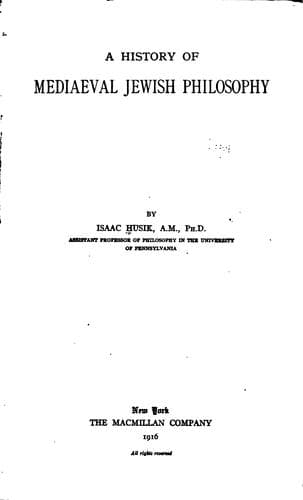
A History of Mediaeval Jewish PhilosophyHusik, Isaac
ReligionJewish
A History of Mediaeval Jewish Philosophy
Husik, Isaac
Philosophy, Jewish; Philosophy, Medieval
The sources of the "Attributes of the Soul" are no doubt the various
Neo-Platonic writings current among the Arabs in the tenth and eleventh
centuries, of which we spoke in the Introduction (p. xx) and in the
chapter on Gabirol (p. 63 f.). Gabirol himself can scarcely have had
much influence on our author, as the distinctive doctrine of the "Fons
Vitæ" is absent in our treatise. The reader will remember that matter
and form, according to Gabirol, are at the basis not merely of the
corporeal world, but that they constitute the essence of the spiritual
world as well, the very first emanation, the Universal Intelligence,
being composed of universal matter and universal form. As we shall see
this is not the view of the "Attributes of the Soul." Matter here
occupies the position which it has in Plotinus and in the encyclopædia
of the Brethren of Purity. It is the fourth in order of emanations, and
the composition of matter and form begins with the celestial sphere,
which is the fifth in order. Everything that precedes matter is
absolutely simple. At the same time it seems clear that he was familiar
with Gabirol's doctrine of the will. For in at least two passages in the
"Attributes of the Soul" (chs. 11 and 13)[134] we have the series,
vegetative soul, spheral impression, [psychic power--omitted in ch. 13],
universal soul, intellect, will.
The "Categories" of Aristotle is also clearly evident in the "Attributes
of the Soul." It is the ultimate source of the definition of accident as
that which resides in substance without being a part of it, but yet in
such a way that without substance it cannot exist.[135] The number of
the species of motion as six[136] points in the same direction. This,
however, does not prove that the author read the "Categories." He might
have derived these notions, as well as the list of the ten categories,
from the writings of the Brethren of Purity. The same thing applies to
the statement that a spiritual substance is distinguished from a
corporeal in its capacity of receiving its qualities or accidents
without limits.[137] This probably goes back to the De Anima of
Aristotle where a similar contrast between the senses and the reason is
used as an argument for the "separate" character of the latter. The
doctrine of the mean in conduct[138] comes from the ethics of Aristotle.
The doctrine of the four virtues and the manner of their derivation is
Platonic,[139] and so is the doctrine of reminiscence, viz., that the
soul recalls the knowledge it had in its previous life.[140]
Ibn Sina is one of the latest authors mentioned in our work; hence it
could not have been written much before 1037, the date of Ibn Sina's
death. The _terminus ad quem_ cannot be determined.
Public-domain text, read in full here on John Shaqi.
Reviews
Reviews
No reviews yet
Be the first to share your thoughts on this work.
Elsewhere in the archive
Join the Discussion
Join the discussion
Sign in to leave a comment or review.
Sign InorCreate an account