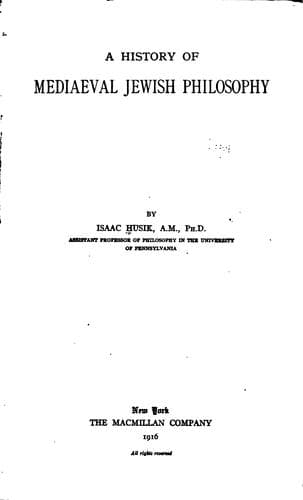
A History of Mediaeval Jewish PhilosophyHusik, Isaac
ReligionJewish
A History of Mediaeval Jewish Philosophy
Husik, Isaac
Philosophy, Jewish; Philosophy, Medieval
To proceed now to give a brief account of Abraham bar Hiyya's teaching,
he thinks it is the duty of rational man to know how it is that man who
is so insignificant was given control of the other animals, and endowed
with the power of wisdom and knowledge. In order to gain this knowledge
we must investigate the origins and principles of existing things, so
that we may arrive at an understanding of things as they are. This the
wise men of other nations have realized, though they were not privileged
to receive a divine Torah, and have busied themselves with philosophical
investigations. Our Bible recommends to us the same method in the words
of Deuteronomy (4, 39), "Know therefore this day, and reflect in thy
heart, that the Lord is God in the heavens above, and upon the earth
beneath: there is none else." This means that if you understand
thoroughly the order of things in heaven above and the earth beneath,
you will at once see that God made it in his wisdom, and that he is the
only one and there is no one beside him. The book of Job teaches the
same thing, when it says (19, 26) "And from my flesh I shall behold
God." This signifies that from the structure of the body and the form of
its members we can understand the wisdom of the Creator. We need not
hesitate therefore to study the works of the ancients and the wise men
of other nations in order to learn from them the nature of existence. We
have the permission and recommendation of Scripture.[153]
Starting from a consideration of man we see that he is the last of
created things because we find in him additional composition over and
above that found in other creatures. Man is a "_rational animal_."
"Animal" means a body that grows and moves and at last is dissolved.
"Rational" refers to the power of knowledge, of inferring one thing from
another, and discriminating between good and evil. In this man differs
from other animals. Descending in the scale of existence we find that
the plant also grows and dies like the animal, but it does not move.
Stones, metals and other inanimate bodies on the earth, change their
forms and shapes, but unlike plants they have no power of growing or
increasing. They are the simplest of the things on the earth. They
differ from the heavenly bodies in that the latter never change their
forms. Proceeding further in our analysis, we find that body, the
simplest thing so far, means length, breadth and depth attached to
something capable of being measured. This definition shows that body is
also composed of two elements, which are theoretically distinct until
God's will joins them together. These are "hyle" (matter)--what has no
likeness or form, but has the capacity of receiving form--and form,
which is defined as that which has power to clothe the hyle with any
form. Matter alone is too weak to sustain itself, unless form comes to
its aid. Form, on the other hand, is not perceptible to sense unless it
clothes matter, which bears it. One needs the other. Matter cannot
Public-domain text, read in full here on John Shaqi.
Reviews
Reviews
No reviews yet
Be the first to share your thoughts on this work.
Elsewhere in the archive
Join the Discussion
Join the discussion
Sign in to leave a comment or review.
Sign InorCreate an account