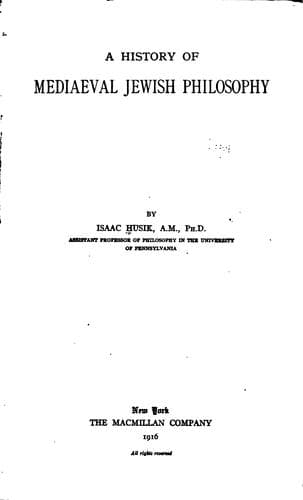
A History of Mediaeval Jewish PhilosophyHusik, Isaac
ReligionJewish
A History of Mediaeval Jewish Philosophy
Husik, Isaac
Philosophy, Jewish; Philosophy, Medieval
These are the views of speculative thinkers which we may adopt, but they
cannot tell us what is the content of the terms _wisdom_ and _right
conduct_. Not having been privileged to receive the sacred Law, which is
the source of all wisdom and the origin of rectitude, they cannot tell
us in concrete fashion just what a man must know and what he must do in
order to raise his soul to the highest degree possible for it to attain.
And if they were to tell us what they understand by wisdom and right
conduct, we should not listen to them. Our authority is the Bible, and
we must test the views of the philosophers by the teaching of the Bible.
If we do this we find authority in Scripture also for belief in the
immortality of the soul. Thus if we study carefully the expressions used
of the various creations in the first chapter of Genesis, we notice that
in some cases the divine command is expressed by the phrase, "Let there
be...," followed by the name of the thing to be created; and the
execution of the command is expressed by the words, "And there was...,"
the name of the created object being repeated; or the phrase may be
simply, "And it was so," without naming the object. In other cases the
expression "Let there be" is not used, nor the corresponding "And there
was."
This variation in expression is not accidental. It is deliberate and
must be understood. Upon a careful examination we cannot fail to see
that where the expression "Let there be" is used, the object so created
exists in this world permanently and without change. Thus, "Let there be
light" (Gen. i, 3). If in addition we have the corresponding expression,
"And there was," in connection with the same object and followed by its
name, it means that the object will continue its everlasting existence
in the next world also. Hence, "And there was light" (_ib._). In the
creation of the firmament and the luminaries we have the expression,
"Let there be"; the corresponding expression at the end is in each case
not, "And there was...," but, "And it was so." This signifies that in
this world, as long as it lasts, the firmament and luminaries are
permanent and without change; but they will have no continuance in the
next world. In the creation of the sublunar world we do not find the
phrase, "Let there be," at all, but such expressions as, "Let the waters
be gathered together" (_ib._ 9), "Let the earth produce grass" (_ib._
11), and so on. This means that these things change their forms and have
no permanent existence in this world. The phrase, "And it was so,"
recording the realization of the divine command, signifies that they do
not exist at all in the next world.
Public-domain text, read in full here on John Shaqi.
Reviews
Reviews
No reviews yet
Be the first to share your thoughts on this work.
Elsewhere in the archive
Join the Discussion
Join the discussion
Sign in to leave a comment or review.
Sign InorCreate an account