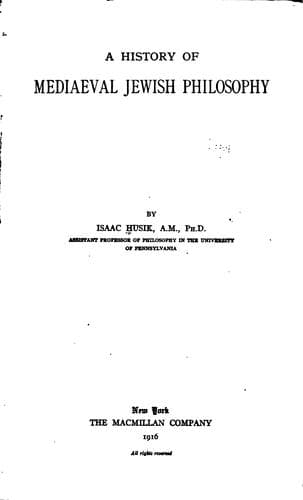
A History of Mediaeval Jewish PhilosophyHusik, Isaac
ReligionJewish
A History of Mediaeval Jewish Philosophy
Husik, Isaac
Philosophy, Jewish; Philosophy, Medieval
Man alone, he tells us, of all animal creation receives reward and
punishment. The other animals have neither merit nor guilt. To be sure,
their fortune in life depends upon the manner in which they respond to
their environment, but this is not in the way of reward and punishment,
but a natural consequence of their natural constitution. With man it is
different, and this is because of the responsible position man occupies,
having been given the privilege and the ability to control all animal
creation.[158]
The psychological basis of virtue in Abraham bar Hiyya is Platonic in
origin, as it is in Pseudo-Bahya, though we do not find the four
cardinal virtues and the derivation of justice from a harmonious
combination of the other three as in the Republic of Plato, to which
Pseudo-Bahya is ultimately indebted.
Man has three powers, we are told, which some call three souls. One is
the power by which he grows and multiplies like the plants of the field.
The second is that by which he moves from place to place. These two
powers he has in common with the animal. The third is that by which he
distinguishes between good and evil, between truth and falsehood,
between a thing and its opposite, and by which he acquires wisdom and
knowledge. This is the soul which distinguishes him from the other
animals. If this soul prevails over the lower two powers, the man is
called meritorious and perfect. If on the other hand the latter prevail
over the soul, the man is accounted like a beast, and is called wicked
and an evil doer. God gives merit to the animal soul for the sake of
the rational soul if the former is obedient to the latter; and on the
other hand imputes guilt to the rational soul and punishes her for the
guilt of the animal soul because she did not succeed in overcoming the
latter.[159]
The question of the relative superiority of the naturally good who feels
no temptation to do wrong, and the temperamental person who has to
sustain a constant struggle with his passions and desires in order to
overcome them is decided by Abraham bar Hiyya in favor of the former on
the ground that the latter is never free from evil thought, whereas the
former is. And he quotes the Rabbis of the Talmud, according to whom the
reward in the future world is not the same for the two types of men. He
who must overcome temptation before he can subject his lower nature to
his reason is rewarded in the next world in a manner bearing resemblance
to the goods and pleasures of this world, and described as precious
stones and tables of gold laden with good things to eat. On the other
hand, the reward of the naturally perfect who is free from temptation is
purely spiritual, and bears no earthly traces. These men are represented
as "sitting under the Throne of Glory with their crowns on their heads
and delighting in the splendor of the Shekinah."[160]
Public-domain text, read in full here on John Shaqi.
Reviews
Reviews
No reviews yet
Be the first to share your thoughts on this work.
Elsewhere in the archive
Join the Discussion
Join the discussion
Sign in to leave a comment or review.
Sign InorCreate an account