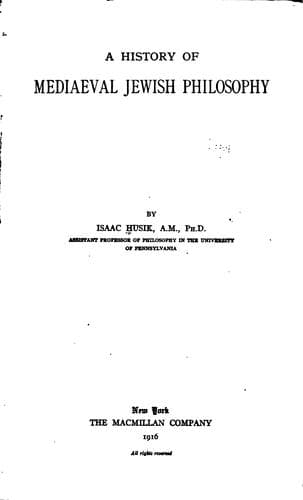
A History of Mediaeval Jewish PhilosophyHusik, Isaac
ReligionJewish
A History of Mediaeval Jewish Philosophy
Husik, Isaac
Philosophy, Jewish; Philosophy, Medieval
The first thing we must do then is to show that the human body is
similar to the corporeal world. This will require an analysis of the
structure of the latter. But before examining the _objects_ of
knowledge, we must say a word about the process of knowing. Man
perceives things in two ways--through sense and through intellect. His
senses give him the accidents of things, the shell or husk, so to speak.
He perceives color through sight, sound through hearing, odor through
smell, and so on. It takes reason to penetrate to the essence of an
object. Take as an example a book. The sense of sight perceives its
color, and through the color its form. This is then apprehended by the
power of imagination or representation. The latter in turn hands it over
to the cogitative power of the rational soul, from the reflection of
which results the spiritual reality of the object, which is its
knowledge. So we see that the reason knows the essence and reality of a
thing, whereas the senses know only its husk and its accidents. This
same thing is stated by the philosopher in another form. The senses, he
says, know only the particular, the universal can be known by the
intellect only. This is because the soul is fine and penetrating, while
the body is gross, and can reach the surface only.
We may also classify knowledge from another point of view as necessary
(or immediate), and demonstrated (or mediate). Necessary knowledge is
that which no sane man can deny. Such knowledge may be of the senses, as
the sight of the sun or the sound of thunder; or it may be of the
reason, such as that the whole is greater than its parts. We may then
enumerate four kinds of things known directly without the help of other
knowledge, (1) The percepts of the senses. (2) Truths generally admitted
by reason of their self-evidence. (3) Traditional truths, _i. e._,
truths handed down by a reliable and wise man, or by a community worthy
of credence. (4) First principles or axioms. These four can be easily
reduced to two; for traditional truths ultimately go back to the
testimony of the senses; while first principles or axioms are included
in self-evident propositions. We thus have two kinds of necessary or
immediate knowledge, the data of sense, and self-evident propositions.
The latter kind is superior to the former, because man shares sense
knowledge with the lower animals; whereas rational propositions are
peculiar to him alone.
Demonstrated knowledge is built upon necessary knowledge, and is derived
from it by means of logical inference.[169]
Public-domain text, read in full here on John Shaqi.
Reviews
Reviews
No reviews yet
Be the first to share your thoughts on this work.
Elsewhere in the archive
Join the Discussion
Join the discussion
Sign in to leave a comment or review.
Sign InorCreate an account