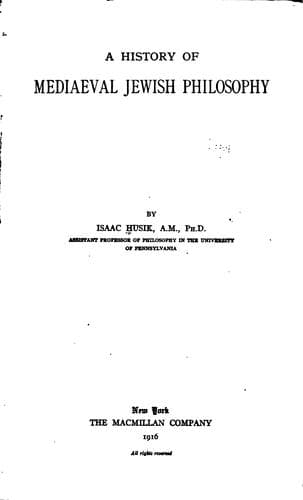
A History of Mediaeval Jewish PhilosophyHusik, Isaac
ReligionJewish
A History of Mediaeval Jewish Philosophy
Husik, Isaac
Philosophy, Jewish; Philosophy, Medieval
The faculty of the vegetative soul is the appetitive power, whose seat
is in the liver. Its subordinate powers are those of nutrition and
growth. Through it man feels the need of food and other natural desires.
He has this in common with the lower animals. It is the first power that
appears in man while he is still in his mother's womb. First comes the
power which forms the combined seed of the male and the female into a
human being in its proper form and nature. In doing this it requires the
assistance of the "growing" power, which begins its activity as soon as
the first member is formed, and continues until the period of youth is
completed. This power in turn needs the assistance of the nourishing
power, which accompanies the other two from the beginning of their
activity to the end of the person's life. All this constitutes the plant
soul, and it must not be supposed that these powers are separated from
one another, and that one is in one place and another in another place.
_They are all spiritual powers derived from the universal powers in the
upper world._
When the form of the being is complete, the animal soul makes its
appearance. This soul is carried in the spirit of the animal or man,
which is found in the pure blood of the arteries. There are two
membranes in every artery, making two passages, one for blood and the
other for the spirit or wind. The seat of the animal soul is in the
heart, and it is borne in the pure red blood. This is why we see in the
heart two receptacles; in one is spirit, in the other, blood. Hence
after death we find congealed blood in the one, while the other is
empty. Death happens on account of the defective "mixture" of the heart.
This means that the four humors of which the body is composed, namely,
blood, yellow and black gall and phlegm, lose the proper proportionality
in their composition, and one or other of them predominates. An animal
does not die unless the mixture of the heart is injured, or the heart is
wounded seriously. Death is also caused by disease or injury of the
brain. For the brain is the origin of the nerves which control the
voluntary activities by means of contraction and expansion. If the chest
does not contract, the warm air does not come out; if it does not
expand, the cold air does not come in; and if the air does not come in
or out, the heart loses its proportionality, and the animal dies. The
functions of the animal soul are sensation and motion. This motion may
be active as well as passive. The active motions are those of the
arteries, and the expansion and contraction of the chest which results
in respiration. The passive motions give rise to the emotions of anger,
fear, shame, joy, sorrow.
Public-domain text, read in full here on John Shaqi.
Reviews
Reviews
No reviews yet
Be the first to share your thoughts on this work.
Elsewhere in the archive
Join the Discussion
Join the discussion
Sign in to leave a comment or review.
Sign InorCreate an account