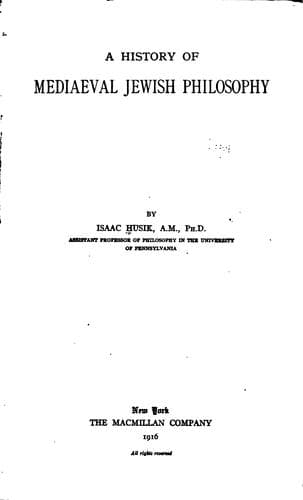
A History of Mediaeval Jewish PhilosophyHusik, Isaac
ReligionJewish
A History of Mediaeval Jewish Philosophy
Husik, Isaac
Philosophy, Jewish; Philosophy, Medieval
Sleep is the rest of the senses, as death is their entire cessation. The
purpose of sleep is to give the brain rest so that the "spirit" of the
soul should not be dissolved and the "mixture" of the body injured
suddenly and cause death. The heart rests continually between
contraction and expansion, hence it needs no special rest at night.
Waking is the activity of the senses and the exercise of their functions
to satisfy the desires of the body. The motions of the soul in the
waking state are in the interest of the needs of the body. During sleep
the soul looks out for itself, for its better world, being then free
from the business of the body. If it is pure and bright, and the body
is free from the remnant of food, and the thought is not depressed by
sorrow and grief--then the soul is aroused in its desire for the future,
and beholds wonderful things.[172]
No one can deny that man has a rational soul because speech is an
attribute which man has above all other animals. The soul is not a
corporeal thing, for if it were it would have to occupy place like body,
and would have color and form and other qualities like body. Moreover,
it would require something else to give it life like body. In other
words, the soul would require another soul, and that soul another soul,
and so on _ad infinitum_, which is impossible. Hence the soul is not a
corporeal thing.
Nor can we say that the soul is _in_ the body. For if it were, it would
itself be body; since only body can fill the empty place in another
body, as water fills a jar.
The soul is a substance and not an accident. An accident is a quality
which makes its appearance in something else, and has no permanence. If
then the rational soul is an accident of the body, it has no permanence,
and man is sometimes rational and sometimes not. This is absurd, for in
that case there could be no purpose in giving him commandments and
statutes.
There are inseparable accidents to be sure, like the color of the
Ethiopian's skin. But in that case we know the color is an accident
despite its inseparability, from the fact that in other things color is
an accident and may be removed. This will not apply to the reason. For
we do not find anything in which reason is a removable accident. The
moment you remove reason, you remove man, for reason is essential to
man. The fact that as a result of an injury a man may lose his reason is
no argument against us, for this happens only when an injury is
inflicted on the brain, which is the reason's instrument. This accounts
for the fact, too, that men in good health if given henbane to drink
lose their reason, because the drink affects the brain. On the other
hand, we see that those afflicted with a certain disease of the
intestines, which causes their death, are more rational and brighter at
the time of death than ever before, showing that the soul cannot be an
accident depending upon the "mixture" of the body.
Public-domain text, read in full here on John Shaqi.
Reviews
Reviews
No reviews yet
Be the first to share your thoughts on this work.
Elsewhere in the archive
Join the Discussion
Join the discussion
Sign in to leave a comment or review.
Sign InorCreate an account