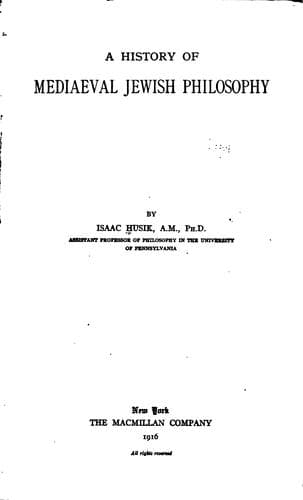
A History of Mediaeval Jewish PhilosophyHusik, Isaac
ReligionJewish
A History of Mediaeval Jewish Philosophy
Husik, Isaac
Philosophy, Jewish; Philosophy, Medieval
The first loss a man suffers who does not study and investigate is that
he does not understand the real existence of God, and imagines he is
worshipping a body. Some think God is light. But this is as bad as to
regard him body. For light is an accident in a shining body, as is
proved by the fact that the air receives the light of the sun, and later
it receives the shadow and becomes dark. And yet these people are not
the worst by any means, for there are others who do not trouble to
concentrate their minds on God, and occupy their thoughts solely with
the business and the pleasures of this world. These people we do not
discuss at all. We are arguing against those who imagine they are wise
men and students of the Kalam. In fact they are ignorant persons, and do
not know what logic is and how it is to be used.
Before giving our own views of the nature and existence of God, we must
refute the objectionable doctrines of these people. Joseph al-Basir in a
work of his called "Mansuri" casts it up to the Rabbanites that in
believing that God descends and ascends they are not true worshippers of
God. But he forgets that his own doctrines are no better. Anyone who
believes that God created with a newly created will and rejects by means
of a newly created rejection has never truly served God or known him.
Just as objectionable is their view that God is living but not with life
residing in a subject, powerful but not with power, and so on. We shall
take up each of these in turn.
The Mutakallimun refuse to believe that God's will is eternal, for fear
of having a second eternal beside God. And so they say that whenever God
wills, he creates a will for the purpose, and whenever he rejects
anything he creates a "rejection" with which the objectionable thing is
rejected. But this leads them to a worse predicament than the one from
which they wish to escape, as we shall see. If God cannot create
anything without having a will as the instrument in creating, and for
this reason must first create a will for the purpose--how did he create
this will? He must have had another will to create this will, and a
third will to create the second, and so on _ad infinitum_, which is
absurd. If he created the first will without the help of another will,
why not create the things he wanted outright without any will? Besides,
in making God will at a given time after a state of not willing, they
introduce change in God.
Public-domain text, read in full here on John Shaqi.
Reviews
Reviews
No reviews yet
Be the first to share your thoughts on this work.
Elsewhere in the archive
Join the Discussion
Join the discussion
Sign in to leave a comment or review.
Sign InorCreate an account