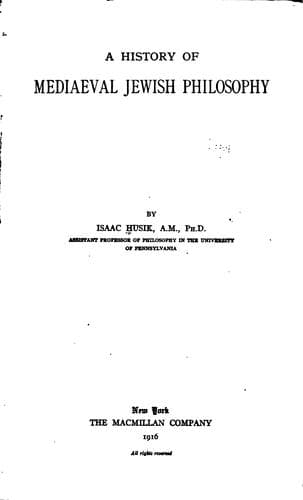
A History of Mediaeval Jewish PhilosophyHusik, Isaac
ReligionJewish
A History of Mediaeval Jewish Philosophy
Husik, Isaac
Philosophy, Jewish; Philosophy, Medieval
Like Saadia and Bahya before him, Ibn Zaddik makes use of the
distinction (or rather takes it for granted) between rational and
traditional commandments; pointing out that the latter also have a cause
and explanation in the mind of God even though we may not know it. In
some cases we can see the explanation ourselves. Take for instance the
observance of the Sabbath. Its rational signification is two-fold. It
teaches us that the world was created, and hence has a Creator whom we
worship. And in the second place the Sabbath symbolizes the future
world. As one has nothing to eat on the Sabbath day unless he has
prepared food the day before, so the enjoyment of the future world
depends upon spiritual preparation in this world.
In his conduct a man must imitate God's actions by doing good and mercy
and kindness. Without the knowledge of God a person's good deeds are of
no account and no better than the work of idolaters. In fact it is not
possible to do good deeds without a knowledge of God, for he is the
source of all good, and there is no true good without him. When a fool
is seen with good qualities such as mercy and benevolence, they are due
to the weakness of his animal soul, the spirited part of his nature.
Similarly if this fool abstains from pleasures, it is because of the
weakness of his appetitive soul.
Thus we see that knowledge comes first in importance; for knowledge
leads to practice, and practice brings reward in the world to come. As
the purpose of man's creation is that he may enjoy the future life,
wisdom or knowledge is the first requisite to this great end.
The four principal qualities constituting goodness or virtue are (1)
knowledge of God's attributes; (2) righteousness or justice; (3) hope;
(4) humility. All other good qualities are derived from these. Jeremiah
names some of them when he says (9, 23), "I am the Lord who exercise
kindness, justice and righteousness on the earth; for in these things I
delight, saith the Lord." Similarly Zephaniah (2, 3) bids us, "Seek ye
the Lord, all ye meek of the earth, who have fulfilled his ordinances;
seek righteousness, seek meekness."
The four qualities of wisdom or knowledge, righteousness, hope and
humility are without doubt modified descendants of the four Platonic
virtues, wisdom, courage, temperance and justice, which we still find in
their original form and in their Platonic derivation and psychological
origin in Pseudo-Bahya (_cf._ above p. 111).
Public-domain text, read in full here on John Shaqi.
Reviews
Reviews
No reviews yet
Be the first to share your thoughts on this work.
Elsewhere in the archive
Join the Discussion
Join the discussion
Sign in to leave a comment or review.
Sign InorCreate an account