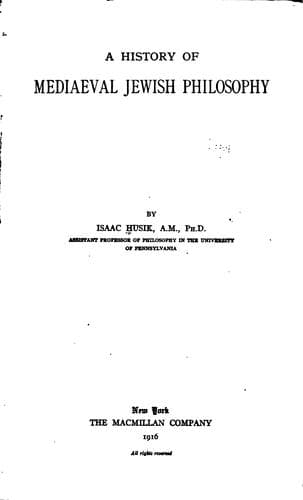
A History of Mediaeval Jewish PhilosophyHusik, Isaac
ReligionJewish
A History of Mediaeval Jewish Philosophy
Husik, Isaac
Philosophy, Jewish; Philosophy, Medieval
Now he becomes a devotee, who loves the object of his devotion,
and is ready to give his life in his love for him, because of the great
happiness he feels in being near to him, and the misery of being away
from him. This is different from the philosopher, who sees in the
worship of God only good ethics and truth, because he is greater than
all other existing things; and in unbelief nothing more than the fault
of choosing the untrue.[189]
Here there is clearly a touch of religious poetry and mysticism, which
reveals to us Halevi's real attitude, and we have no difficulty in
understanding his lack of sympathy with what seemed to him the shallow
rationalism of the contemporaneous Aristotelian, who fancied in his
conceit that with a few logical formulæ he could penetrate the
mysteries of the divine, when in reality he was barely enabled to skim
the surface; into the sanctuary he could never enter.
Though, as we have just seen, Halevi has a conception of God as a
personal being, acting with purpose and will and, as we shall see more
clearly later, standing in close personal relation to Israel and the
land of Palestine, still he is very far from thinking of him
anthropomorphically. In his discussion of the divine attributes he
yields to none in removing from God any positive quality of those
ascribed to him in the Bible. The various names or appellatives applied
to God in Scripture, except the tetragrammaton, he divides, according to
their signification, into three classes, _actional_, _relative_,
_negative_. Such expressions as "making high," "making low," "making
poor," almighty, strong, jealous, revengeful, gracious, merciful, and so
on, do not denote, he says, feeling or emotion in God. They are ascribed
to him because of his visible acts or effects in the world, which we
judge on the analogy of our own acts. As a human being is prompted to
remove the misery of a fellowman because he feels pity, we ascribe all
instances of divine removal of misery from mankind to a similar feeling
in God, and call him merciful. But this is only a figure of speech. God
does remove misery, but the feeling of pity is foreign to him. We call
therefore the attribute merciful and others like it actional, meaning
that it is God's acts which suggest to us these appellations.
Public-domain text, read in full here on John Shaqi.
Reviews
Reviews
No reviews yet
Be the first to share your thoughts on this work.
Elsewhere in the archive
Join the Discussion
Join the discussion
Sign in to leave a comment or review.
Sign InorCreate an account