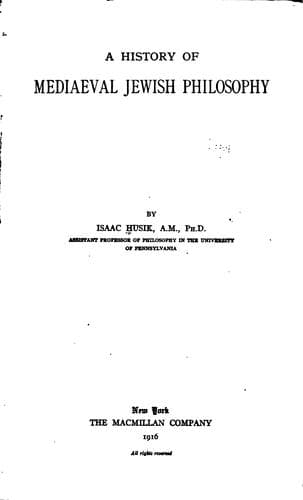
A History of Mediaeval Jewish PhilosophyHusik, Isaac
ReligionJewish
A History of Mediaeval Jewish Philosophy
Husik, Isaac
Philosophy, Jewish; Philosophy, Medieval
proximity of different parts to the revolving lunar sphere explains why
some parts became fire, some air, and so on.
To this mechanical explanation of the formation of the elements Judah
Halevi objects. As long as the original motion of the diurnal sphere is
admittedly due not to chance but to the will of God, what is gained by
referring the formation of the elements to their accidental proximity to
the moving sphere, and accounting for the production of mineral, plant
and animal in the same mechanical way by the accidental composition of
the four elements in proportions varying according to the different
revolutions and positions of the heavenly bodies? Besides if the latter
explanation were true, the number of species of plants and animals
should be infinite like the various positions and formations of the
heavenly bodies, whereas they are finite and constant. The argument from
the design and purpose that is clearly visible in the majority of plants
and animals further refutes such mechanical explanation as is attempted
by the philosophers. Design is also visible in the violation of the
natural law by which water should always be above and around earth;
whereas in reality we see a great part of the earth's surface above
water. This is clearly a beneficent provision in order that animal life
may sustain itself, and this is the significance of the words of the
Psalmist (136, 6), "To him that stretched out the earth above the
waters."
The entire theory of the four elements and the alleged composition of
all things out of them is a pure assumption. Take the idea of the world
of fire, the upper fire as they call it, which is colorless, so as not
to obstruct the color of the heavens and the stars. Whoever saw such a
fire? The only fire we know is an extremely hot object in the shape of
coal, or as a flame in the air, or as boiling water. And whoever saw a
fiery or aëry body enter the matter of plant and animal so as to warrant
us in saying that the latter are composed of the four elements? True, we
know that water and earth do enter the matter of plants, and that they
are assisted by the air and the heat of the sun in causing the plant to
grow and develop, but we never see a fiery or aëry body. Or whoever saw
plants resolved into the four elements? If a part changes into earth, it
is not real earth, but ashes; and the part changed to water is not real
water, but a kind of moisture, poisonous or nutritious, but not water
fit for drinking. Similarly no part of the plant changes to real air fit
for breathing, but to vapor or mist. Granted that we have to admit the
warm and the cold, and the moist and the dry as the primary qualities
without which no body can exist; and that the reason resolves the
composite objects into these primary qualities, and posits substances as
bearers of these qualities, which it calls fire, air, water and
earth--this is true conceptually and theoretically only. It cannot be
Public-domain text, read in full here on John Shaqi.
Reviews
Reviews
No reviews yet
Be the first to share your thoughts on this work.
Elsewhere in the archive
Join the Discussion
Join the discussion
Sign in to leave a comment or review.
Sign InorCreate an account