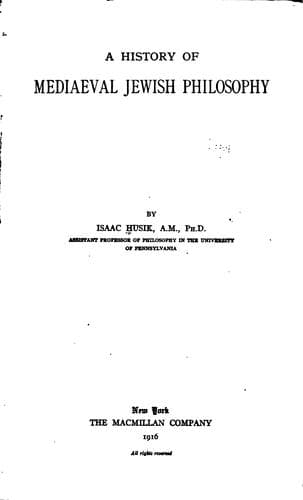
A History of Mediaeval Jewish PhilosophyHusik, Isaac
ReligionJewish
A History of Mediaeval Jewish Philosophy
Husik, Isaac
Philosophy, Jewish; Philosophy, Medieval
Judging from the position of man among the other creatures of the
sublunar world, we come to the conclusion, he tells us, that that which
distinguishes him above his surroundings, namely, his rational soul, is
the aim of all the rest; and they are means and preparations for it. The
rational soul has two forms of activity. It may face upward and receive
wisdom from the angels (theoretical knowledge). Or it may direct its
attention downwards and judge the other corporeal powers (practical
reason). But it must not devote itself unduly or without system to any
one occupation. The aim of man is wisdom, science. Of the sciences the
highest and the aim of all the rest is the knowledge of God. The body of
man is his animal, which leads him to God. Some spend all their time in
feeding the animal, some in clothing it, and some in curing it of its
ills. The latter is not a bad occupation, as it saves the body from
disease and death, and so helps it to attain the higher life. But to
think of the study of medicine as the aim of life and devote all one's
time to it is doing injury to one's soul. Some spend their time in
matters even less significant than this, _viz._, in studying grammar and
language; others again in mathematics and in solving curious problems
which are never likely to happen. The only valuable part here is that
which has relation to astronomy. Some are exclusively occupied in
"twisting threads." This is an expression used by an Arabian
philosopher,[230] who compares man's condition in the world to that of a
slave who was promised freedom and royalty besides if he made the
pilgrimage to Mecca and celebrated there. If he made the journey and was
prevented from reaching the holy city, he would get freedom only; but if
he did not undertake the trip he would get nothing. The three steps in
the realization of the purpose are thus: making the preparations for the
journey, getting on the road and passing from station to station, and
finally wandering about in the place of destination. One small element
in the preparation for the journey is twisting the threads for the water
bottle. Medicine and law as means of gaining a livelihood and a
reputation represent the stage of preparing for the journey. They are
both intended to improve the ills of life, whether in the relations of
man to man as in law; or in the treatment of the internal humors as in
medicine. Medicine seems more important, for on the assumption of
mankind being just, there would be no need of law, whereas the need for
medicine would remain. To spend one's whole life in legal casuistry and
the working out of hypothetical cases on the pretext of sharpening one's
wits, is like being engaged in twisting threads continually--a little is
necessary, but a great deal is a waste of time. It would be best if the
religious man would first learn how to prove the existence of God, the
meaning of prophecy, the nature of reward and punishment and the future
Public-domain text, read in full here on John Shaqi.
Reviews
Reviews
No reviews yet
Be the first to share your thoughts on this work.
Elsewhere in the archive
Join the Discussion
Join the discussion
Sign in to leave a comment or review.
Sign InorCreate an account