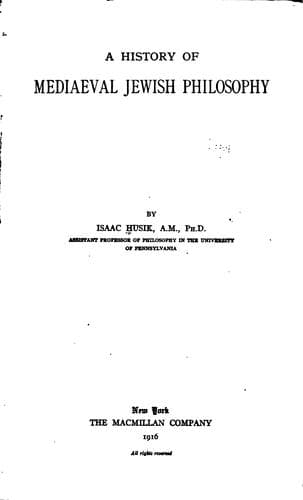
A History of Mediaeval Jewish PhilosophyHusik, Isaac
ReligionJewish
A History of Mediaeval Jewish Philosophy
Husik, Isaac
Philosophy, Jewish; Philosophy, Medieval
Although it is thus true that the rational soul is independent of the
body, nevertheless it did not exist before the body any more than the
lower souls. For if it did, it was either one soul for all men, or there
were as many souls as there are individual men. The first is impossible;
for the same soul would then be wise and ignorant, good and bad, which
is impossible. Nor could the separate souls be different, for being all
human souls they cannot differ in essence, which is their common
humanity. But neither can they differ in accidental qualities, for
simple substances have no accidents. They cannot therefore be either one
or many, _i. e._, they cannot be at all before body.
Nor must we suppose because the reason exercises its thought functions
without the use of a corporeal organ that it appears full fledged in
actual perfection in the person of the infant. Experience teaches
otherwise. The perfections of the human soul are in the child potential.
Later on by divine assistance he acquires the first principles of
knowledge about which there is no dispute, such as that two things equal
to the same thing are equal to each other, that two contrary predicates
cannot apply to the same subject at the same time in the same relation,
and so on. Some of these are the fundamental principles of mathematics,
others of other sciences. Then he progresses further and learns to make
premises and construct syllogisms and argue from the known to the
unknown. We have thus three stages in the development of the reason. The
first potential stage is known as the _hylic_ or _potential intellect_.
The second is known as the _actual intellect_, and the third is the
_acquired intellect_. If not for the body the person could not make this
progress. For without body there are no senses, and without senses he
would not see how the wine in the barrel ferments and increases in
volume, which suggests that quantity is accident and body is substance.
Nor would he learn the distinction between quality and substance if he
did not observe a white garment turning black, or a hot body becoming
cold. There is need therefore of the body with its senses to lead to a
knowledge of the universals. But this knowledge once acquired, the soul
needs not the body for its subsequent existence; and as the soul is not
a corporeal power, the death of the body does not cause the extinction
of the soul.
Some think that because the soul is the form of the body it is dependent
upon it and cannot survive it, as no other form survives its substance.
But this inference is not valid. For if the human soul is included in
the statement that no form survives its matter, we assume what we want
to prove, and there is no need of the argument. If it is not as a matter
of fact included, because it is the question at issue, its comparison
with the other observed cases is simply a matter of opinion and not
decisive.
Public-domain text, read in full here on John Shaqi.
Reviews
Reviews
No reviews yet
Be the first to share your thoughts on this work.
Elsewhere in the archive
Join the Discussion
Join the discussion
Sign in to leave a comment or review.
Sign InorCreate an account