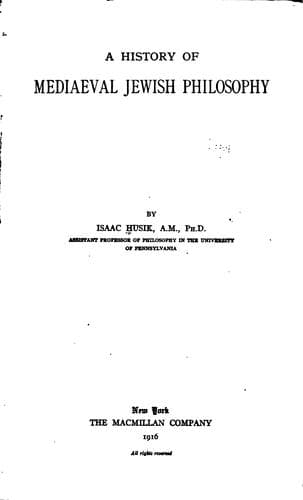
A History of Mediaeval Jewish PhilosophyHusik, Isaac
ReligionJewish
A History of Mediaeval Jewish Philosophy
Husik, Isaac
Philosophy, Jewish; Philosophy, Medieval
He closes his discussion of the attributes by intimating that he has
more to say on this topic, but had better be content with what has been
said so far, for a more thorough discussion of these matters in a book
might do harm to those who do not understand and interpret the author's
words incorrectly. This reminds us of Maimonides's adjuration of the
reader to keep what he finds in the "Guide of the Perplexed" to himself
and not to spread it abroad. Philosophy clearly was a delicate subject
and not meant for intellectual babes, whose intellectual digestion might
be seriously disturbed.[239]
We have now concluded our theory of God and his attributes; and in doing
so we made use of principles of physics, such as matter and form,
potentiality and actuality, motion and infinity. The next step is to
prove the existence and nature of intermediate spiritual beings between
God and the corporeal objects of the superlunar and sublunar worlds,
called angels in the Bible, and secondary causes by the philosophers.
For this purpose we shall have to apply the principles we have proved
concerning the soul and the motions of the heavenly bodies. We have
proved above that the human soul is at first in the child intelligent
potentially and then becomes intelligent actually. This requires an
agent, in whom the end to which the potential is proceeding is always
actual. As the rational soul is neither body nor a corporeal power, this
actual agent cannot be either of these, hence it is neither a sphere nor
the soul of a sphere, but it must be a simple substance called _Active
Intellect_. The prophets call it "Holy Spirit" ("Ruah Ha-Kodesh"). We
thus have a proof of the existence of at least one such simple
intellectual substance, or angel, the relation of which to the human
soul is as that of light to vision. Without light vision is potential,
light makes it actual. So the active intellect makes the potential soul
actual and gives it first the axioms, which are universally certain, and
hence could not have originated by induction from experience.
Public-domain text, read in full here on John Shaqi.
Reviews
Reviews
No reviews yet
Be the first to share your thoughts on this work.
Elsewhere in the archive
Join the Discussion
Join the discussion
Sign in to leave a comment or review.
Sign InorCreate an account