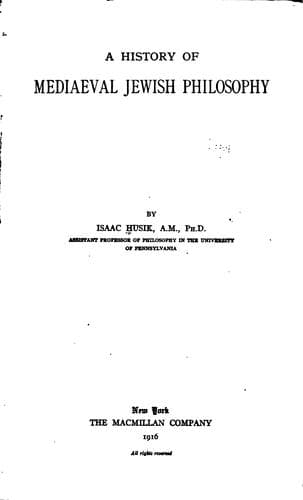
A History of Mediaeval Jewish PhilosophyHusik, Isaac
ReligionJewish
A History of Mediaeval Jewish Philosophy
Husik, Isaac
Philosophy, Jewish; Philosophy, Medieval
The explanation of Ibn Daud--it was not original with him, as we have
already seen the non-religious philosopher in Halevi's Cusari giving
utterance to the same idea, and in Jewish philosophy Israeli touches on
it--the explanation of Ibn Daud is grounded in his psychology, the
Aristotelian psychology of Avicenna. The first degree of prophecy, he
says, is found in true dreams, which happen to many people. Just as
waking is a state of the body in which it uses the external as well as
the internal senses, so sleeping is a state of the body in which the
soul suppresses the external senses by putting them to sleep, and
exercises its "natural" powers only, such as the beating of the heart
pulse, respiration, and so on. The internal senses are also at work
during sleep, or at least some of them. In particular the power of
imagination is active when the external senses are at rest. It then
makes various combinations and separations and brings them to the common
sense. The result is a dream, true or false. When the senses are weak
for one reason or another this power becomes active and, when not
controlled by the reason, produces a great many erroneous visions and
ideas, as in the delusions of the sick.
The Deity and the angels and the Active Intellect have a knowledge of
the past, present and future, and we already know that the soul, _i. e._,
the rational soul, receives influence from the Active Intellect as
a natural thing in every person. Now just as it gets from it science and
general ideas, so it may receive a knowledge of hidden things if the
soul is adequately prepared. The reason it cannot receive information of
hidden things from the Active Intellect in its waking state, is because
the soul is then busy in acquiring knowledge through the senses. In
sleep, too, it may be prevented by the thick vapors rising from the food
consumed during the day, or by anxiety due to want of food or drink. The
imagination also sometimes hinders this process by the constant
presentation of its foolish combinations to the common sense. But
sometimes this power comes under the control of the reason, and then the
rational soul is prepared to receive hidden things from the Active
Intellect. In those cases the imagination transforms these facts into
images, which are true dreams. If they concern an individual or a
particular event, we do not call them prophecy, or at least the share of
prophecy they may have is very small. We call them prophetic dreams when
they concern important matters and have reference to a whole nation or
nations, and come to pass in the distant future. An example of such a
dream is that recorded in Daniel 7, 1.
Public-domain text, read in full here on John Shaqi.
Reviews
Reviews
No reviews yet
Be the first to share your thoughts on this work.
Elsewhere in the archive
Join the Discussion
Join the discussion
Sign in to leave a comment or review.
Sign InorCreate an account