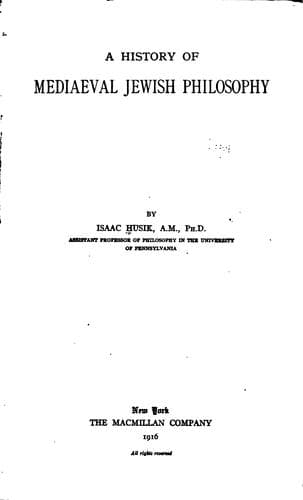
A History of Mediaeval Jewish PhilosophyHusik, Isaac
ReligionJewish
A History of Mediaeval Jewish Philosophy
Husik, Isaac
Philosophy, Jewish; Philosophy, Medieval
One may argue that it is in the nature of man that he should have
understanding and perfection; and if God deprives him of it, he does
evil. The answer is that the evil in the world is very small in
comparison with the good. For evil and defect are found only in things
composed of the elements, which have a common matter, receiving forms in
accordance with the mixture of the elementary qualities in the matter.
Here an external cause sometimes prevents the form from coming to the
matter in its perfection. The seed, for example, depends upon the
character of the soil which it finds for its growth. Now it does not
follow that God was bound to give things the highest perfection
possible. For in that case all minerals would be plants, all plants
animals, all animals men, all men angels; and there would be no world,
but only God and a few of the highest angels. In order that there shall
be a world, it was necessary to make a graduated series as we actually
have it. And as a matter of fact the very defects in the material
composites are a good when we have in view not the particular thing but
the whole. Thus if all men were of a highly intellectual type, there
would be no agriculture or manual labor.
Now there are men whose temperament is such that they cannot distinguish
between right and wrong, and they follow their inclinations. To
counteract these bad qualities God gave his commandments and warnings.
This shows that it is not impossible to oppose these evil tendencies,
for in that case the commandments would be useless. The acts of man come
neither under the category of the _necessary_, nor under that of the
_impossible_, but under the category of the _possible_.
There are two senses in which we may understand the term possible. A
thing may be possible subjectively, _i. e._, in relation to our
ignorance, though objectively it may be necessary and determined. Thus
we in Spain do not know whether the king of Babylon died to-day or not;
and so far as we are concerned, it is possible that he is dead or that
he is alive. In reality it is not a question of possibility but of
necessity. God knows which is true. The same thing applies to the
occurrence of an eclipse in the future for the man who is ignorant of
astronomy. Such possibility due to ignorance does not exist in God.
Public-domain text, read in full here on John Shaqi.
Reviews
Reviews
No reviews yet
Be the first to share your thoughts on this work.
Elsewhere in the archive
Join the Discussion
Join the discussion
Sign in to leave a comment or review.
Sign InorCreate an account