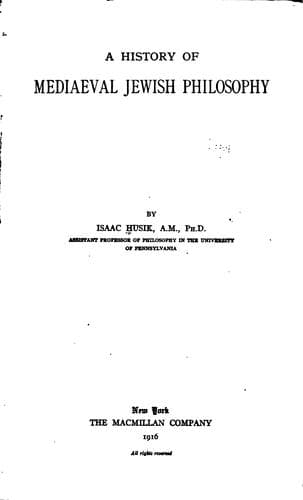
A History of Mediaeval Jewish PhilosophyHusik, Isaac
ReligionJewish
A History of Mediaeval Jewish Philosophy
Husik, Isaac
Philosophy, Jewish; Philosophy, Medieval
The human soul consists of three principal faculties, vegetative,
animal, rational. Corresponding to these the principal virtues and vices
are also three. The vegetative power, whose functions are nourishment,
growth and reproduction, is related to appetite, and is called the
appetitive soul. The animal power as being the cause of sensation,
voluntary motion, cruelty, revenge, mercy and kindness, is called the
spirited soul, because these qualities are dependent upon the energy or
weakness of the spirit. The rational power has two aspects. One is
directed upwards and is the means of our learning the sciences and the
arts. The other aspect is directed downwards, and endeavors to control
(successfully or not as the case may be), the two lower powers of the
soul, guarding them against excess and defect. This function we call
conduct, and virtue is the mean between the two extremes of too much and
too little. The mean of the appetitive power is temperance; of the
spirited power, bravery and gentleness; of the rational soul,
justice.[245]
Justice consists in giving everything its due without excess or defect.
Justice is therefore the highest of all qualities, and is of value not
merely in a person's relations to his family and country, but also in
the relations of his powers one to another. The rational power must see
to it that the two lower faculties of the soul get what is their due, no
more and no less. This quality has an important application also in the
relations of a man to his maker. It is just that a person should requite
his benefactor as much as he received from him, if possible. If he
cannot do this, he should at least thank him. Hence the reason for
divine worship, the first of commandments. This quality, the greatest of
men possessed in the highest degree. Moses "said to him that did the
wrong, wherefore smitest thou thy fellow?" (Ex. 2, 13). And when the
shepherds came and drove away the daughters of the priest of Midian,
"Moses stood up and helped them, and watered their flock" (_ib._ 17).
This is the reason why God sent him to deliver Israel.
Public-domain text, read in full here on John Shaqi.
Reviews
Reviews
No reviews yet
Be the first to share your thoughts on this work.
Elsewhere in the archive
Join the Discussion
Join the discussion
Sign in to leave a comment or review.
Sign InorCreate an account