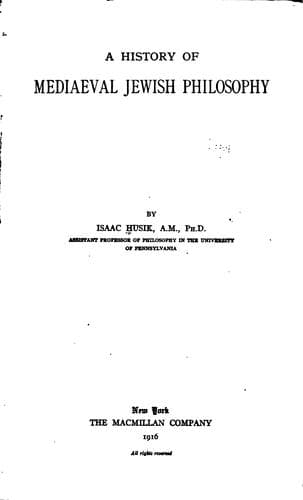
A History of Mediaeval Jewish PhilosophyHusik, Isaac
ReligionJewish
A History of Mediaeval Jewish Philosophy
Husik, Isaac
Philosophy, Jewish; Philosophy, Medieval
We have in these pages followed their ideas--Saadia,
Gabirol, Ibn Zaddik, Abraham Ibn Daud. The latter in particular
anticipated Maimonides in almost all his ideas. None had the effect of
upsetting the theological equilibrium of Jewry. Everyone had his
admirers, no doubt, as well as his opponents. Gabirol was forgotten, Ibn
Zaddik and Ibn Daud were neglected, and Jewish learning continued the
even tenor of its course. Maimonides was the first to make a profound
impression, the first who succeeded in stirring to their depths the
smooth, though here and there somewhat turbid, Rabbinic waters, as they
flowed not merely in scientific Spain and Provence, or in the Orient,
but also in the strictly Talmudic communities of northern France. It was
the Commentary on the Mishna and the Talmudic code known as the "Yad
ha-Hazaka" that was responsible for the tremendous effect of the "More
Nebukim" ("Guide of the Perplexed").
In these two Rabbinical treatises, and particularly in the "Yad
ha-Hazaka," the Rabbinic Code, Maimonides showed himself the master of
Rabbinic literature. And all recognized in him the master mind. Having
been written in Hebrew the Code soon penetrated all Jewish communities
everywhere, and Maimonides's fame spread wherever there were Jews
engaged in the study of the Talmud. His fame as a court physician in
Egypt and as the official head of Oriental Jewry enhanced the influence
of his name and his work. Jealousy no doubt had its share in starting
opposition to the Code itself even before the publication of the
"Guide," and during the lifetime of its author. When the "More Nebukim"
was translated from the original Arabic into Hebrew, so that all could
read it, and Maimonides was no longer among the living, the zealots
became emboldened and the storm broke, the details of which, however, it
is not our province to relate.
For completeness' sake let us set down the facts of his life. Moses ben
Maimon was born in the city of Cordova on the fourteenth of Nissan (30th
of March) at one o'clock in the afternoon, on a Sabbath which was the
day before Passover, in the year 1135. It is not often that the birth of
a mediæval Jewish writer is handed down with such minute detail. Usually
we do not even know the year, to say nothing of the day and the hour.
Cordova had long fallen from its high estate. It was no longer the
glorious city of the days before the Almoravid conquest. And it was
destined to descend lower still when the fanatical hordes of the
Almohades renewed the ancient motto of the early Mohammedan conquerors,
"The Koran or the Sword."
Public-domain text, read in full here on John Shaqi.
Reviews
Reviews
No reviews yet
Be the first to share your thoughts on this work.
Elsewhere in the archive
Join the Discussion
Join the discussion
Sign in to leave a comment or review.
Sign InorCreate an account