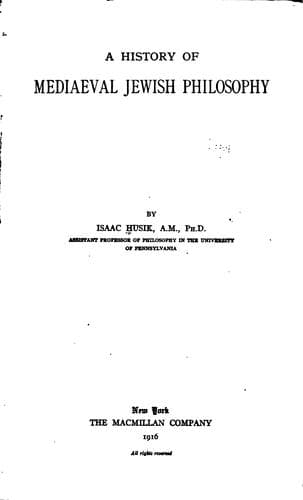
A History of Mediaeval Jewish PhilosophyHusik, Isaac
ReligionJewish
A History of Mediaeval Jewish Philosophy
Husik, Isaac
Philosophy, Jewish; Philosophy, Medieval
I promised in my commentary on the Mishna, he tells us in the
introduction to the "Guide," to explain the allegories and "Midrashim"
in two works to be entitled "The Book of Reconciliation" and "The Book
of Prophecy." But after reflecting on the matter a number of years I
decided to desist from the attempt. The reasons are these. If I
expressed my explanations obscurely, I should have accomplished nothing
by substituting one unintelligible statement for another. If, on the
other hand, I were really to make clear the matters that require
explanation, the result would not be suitable for the masses, for whom
those treatises were intended. Besides, those Midrashim when read by an
ignorant man are harmless because to such a person nothing is
impossible. And if they are read by a person who is learned and worthy,
one of two things is likely to happen. Either he will take them
literally and suspect the author of ignorance, which is not a serious
offence; or he will regard the legendary statements as containing an
esoteric meaning and think well of the author--which is a good thing,
whether he catch the meaning intended or not. Accordingly I gave up the
idea of writing the books mentioned. In this work I am addressing myself
to those who have been philosophizing; who are believers in the Bible
and at the same time know science; and are perplexed in their ideas on
account of the homonymous terms.
Having made clear Maimonides's chief interest and purpose in his
masterpiece we need not follow his own method of treatment, which often
gives the impression of a studied attempt to conceal his innermost ideas
from all but the initiated. At least he is not willing that anyone who
has not taken the trouble carefully to study and scrutinize every
chapter and compare it with what precedes and follows, should by a
superficial browsing here and there arrive at an understanding of the
profound problems treated in the work. He believes that the mysterious
doctrines passing by the name of "Maase Bereshit" and "Maase Merkaba" in
the Talmud (_cf._ Introduction, p. xvi) denote respectively Physics and
Metaphysics--the very sciences of which he treats in the "Guide."
Accordingly he tells us that following the instructions of the Rabbis he
must not be expected to give more than bare allusions. And even these
are not arranged in order in the book, but scattered and mixed up with
other subjects which he desires to explain. For, as he says, "I do not
want to oppose the divine intention, which concealed the truths of his
being from the masses."
Public-domain text, read in full here on John Shaqi.
Reviews
Reviews
No reviews yet
Be the first to share your thoughts on this work.
Elsewhere in the archive
Join the Discussion
Join the discussion
Sign in to leave a comment or review.
Sign InorCreate an account