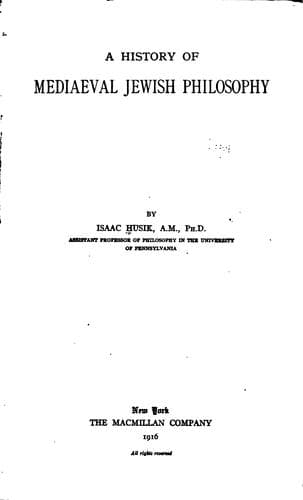
A History of Mediaeval Jewish PhilosophyHusik, Isaac
ReligionJewish
A History of Mediaeval Jewish Philosophy
Husik, Isaac
Philosophy, Jewish; Philosophy, Medieval
This is a new contribution of Maimonides. All the Jewish writers before
Halevi followed in their proofs of the existence of God the method
designated by Maimonides as that of the Kalam. Judah Halevi criticised
the Mutakallimun as well as the philosophers in the interest of a point
of view all his own (pp. 176 ff., 182). Ibn Daud tacitly ignored the
Kalam and based his proof of the existence of God upon the principles of
motion as exhibited in the Aristotelian Physics, without, however,
finding it necessary to assume even provisionally the eternity of motion
and the world (p. 217 ff.). His proof of the incorporeality of God is,
as we have seen (_ibid._), weak, just because he does not admit the
eternity of motion, which alone implies infinity of power in God and
hence incorporeality. Maimonides is the first who takes deliberate
account of the Mutakallimun, gives an adequate outline of the essentials
of their teaching and administers a crushing blow to their principles as
well as their method. He then follows up his destructive criticism with
a constructive method, in which he frankly admits that in order to
establish the existence, unity and incorporeality of God--the three
fundamental dogmas of Judaism--beyond the possibility of cavil, we must
make common cause with the philosophers even though it be only for a
moment, until they have done our work for us, and then we may fairly
turn on our benefactors and taking advantage of their weakness, strike
them down, and upon their lifeless arguments for the eternity of the
world establish our own more plausible theory of creation. The attitude
of Maimonides is in brief this. If we were certain of creation, we
should not have to bother with the philosophers. Creation implies the
existence of God. But the question cannot be strictly demonstrated
either way. Hence let us prove the existence of God on the least
promising hypothesis, namely, that of eternity, and we are quite secure
against all possible criticism.
Of the twelve propositions of the Mutakallimun enumerated by Maimonides
as the basis of their doctrine of God, we shall select a few of the most
important.[264]
1. _The Theory of Atoms._ The entire universe is made up of indivisible
bodies having no magnitude. Their combination produces magnitude and
corporeality. They are all alike. Genesis and dissolution means simply
the combination or rather aggregation of atoms and their separation.
These atoms are not eternal, as Epicurus believed them to be, but
created.
2. This atomic theory they extend from magnitude to time. Time also
according to them is composed of moments or atomic units of time.
Neither magnitude, nor matter, nor time is continuous or infinitely
divisible.
Public-domain text, read in full here on John Shaqi.
Reviews
Reviews
No reviews yet
Be the first to share your thoughts on this work.
Elsewhere in the archive
Join the Discussion
Join the discussion
Sign in to leave a comment or review.
Sign InorCreate an account