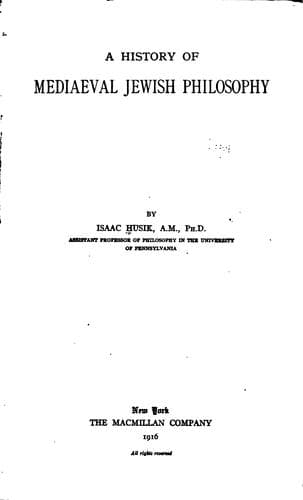
A History of Mediaeval Jewish PhilosophyHusik, Isaac
ReligionJewish
A History of Mediaeval Jewish Philosophy
Husik, Isaac
Philosophy, Jewish; Philosophy, Medieval
We have thus proved with one stroke God's existence as well as his unity
and incorporeality. But, it will be observed, if not for the
twenty-sixth proposition concerning the eternity of motion, which
implies an infinite power, we should not have been forced to the
alternative (b), and could have adopted (c) as well as (d). That is, we
might have concluded that God is the soul of the heavenly sphere
resident within it, or even that he is a corporeal force pervading the
extension of the sphere as heat pervades an ordinary body. But we must
admit that in this way we prove only the existence of a God who is the
cause of the heavenly motions, and through these of the processes of
genesis and decay, hence of all the life of our sublunar world. This is
not the God of Jewish tradition, who creates out of nothing, who is the
cause of the being of the universe as well as of its life processes.
Maimonides was aware of this defect in the Aristotelian view, and he
later repudiates the Stagirite's theory of eternal motion on
philosophical as well as religious grounds. Before, however, we speak of
Maimonides's attitude in this matter, we must for completeness' sake
briefly mention three other proofs for the existence of God as given by
Maimonides. They are not strictly Aristotelian, though they are based
upon Peripatetic principles cited above and due to the Arabian
commentators of Aristotle.
The second proof is as follows. If we find a thing composed of two
elements, and one of these elements is also found separately, it follows
that the other element is found separately also. Now we frequently find
the two elements of _causing motion_ and _being moved_ combined in the
same object. And we also find things which are moved only, but do not
cause motion, as for example matter, or the stone in the last proof. It
stands to reason therefore that there is something that causes motion
without being itself subject to motion. Not being subject to motion, it
is indivisible, incorporeal and not subject to time, as above.
Public-domain text, read in full here on John Shaqi.
Reviews
Reviews
No reviews yet
Be the first to share your thoughts on this work.
Elsewhere in the archive
Join the Discussion
Join the discussion
Sign in to leave a comment or review.
Sign InorCreate an account