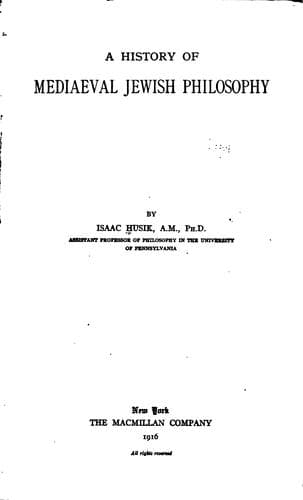
A History of Mediaeval Jewish PhilosophyHusik, Isaac
ReligionJewish
A History of Mediaeval Jewish Philosophy
Husik, Isaac
Philosophy, Jewish; Philosophy, Medieval
Having disposed of crude anthropomorphism we must now take up the
problem of attributes, which endangers the unity. It is a self-evident
truth that an attribute is something different from the essence of a
thing. It is an accident added to the essence. Otherwise it is the thing
over again, or it is the definition of the thing and the explanation of
the name, and signifies that the thing is composed of these elements. If
we say God has many attributes, it will follow that there are many
eternals. The only belief in true unity is to think that God is one
simple substance without composition or multiplicity of elements, but
one in all respects and aspects. Some go so far as to say that the
divine attributes are neither God's essence nor anything outside of his
essence. This is absurd. It is saying words which have nothing
corresponding to them in fact. A thing is either the same as another, or
it is not the same. There is no other alternative. The imagination is
responsible for this error. Because bodies as we know them always have
attributes, they thought that God, too, is made up of many essential
elements or attributes.
Attributes may be of five kinds:
1. The attributes of a thing may be its definition, which denotes its
essence as determined by its causes. This everyone will admit cannot be
in God, for God has no cause, hence cannot be defined.
2. An attribute may consist of a part of a definition, as when we say,
"man is rational," where the attribute rational is part of the
definition of man, "rational animal" being the whole definition. This
can apply to God no more than the first; for if there is a part in God's
essence, he is composite.
3. An attribute may be an expression which characterizes not the essence
of the thing but its quality. Quality is one of the nine categories of
accident, and God has no accidents.
4. An attribute may indicate relation, such as father, master, son,
slave. At first sight it might seem as if this kind of attribute may be
applicable to God; but after reflection we find that it is not. There
can be no relation of time between God and anything else; because time
is the measure of motion, and motion is an accident of body. God is not
corporeal. In the same way it is clear that there cannot be a relation
of place between God and other things. But neither can there be any
other kind of relation between God and his creation. For God is a
necessary existent, while everything else is a possible existent. A
relation exists only between things of the same proximate species, as
between white and black. If the things have only a common genus, and
still more so if they belong to two different genera, there is no
relation between them. If there were a relation between God and other
things, he would have the accident of relation, though relation is the
least serious of attributes, since it does not necessitate a
multiplicity of eternals, nor change in God's essence owing to change in
the related things.
Public-domain text, read in full here on John Shaqi.
Reviews
Reviews
No reviews yet
Be the first to share your thoughts on this work.
Elsewhere in the archive
Join the Discussion
Join the discussion
Sign in to leave a comment or review.
Sign InorCreate an account