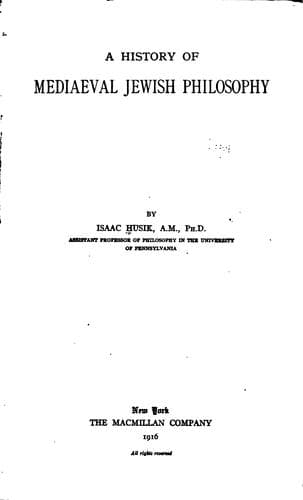
A History of Mediaeval Jewish PhilosophyHusik, Isaac
ReligionJewish
A History of Mediaeval Jewish Philosophy
Husik, Isaac
Philosophy, Jewish; Philosophy, Medieval
That the forms thus impressed on the common sense in sleep are
intermediate between corporeal and spiritual is proved by the fact that
they are different from the corporeal forms of things seen in the waking
state. The latter are obscure and covered up, whereas those seen in
sleep are finer, more spiritual and brighter. Proof of this is that a
person sees himself in sleep endowed with wings and flying between
heaven and earth. He sees the heavens opening and someone speaking to
him out of the heaven, and so on. There would be no sense in all this if
these phenomena had no spiritual meaning, for they are contrary to
nature. But we know that they have real significance if interpreted by a
really thoughtful person. The prophets also in wishing to separate
themselves from mankind and impress the latter with their qualities,
showed them spiritual forms of similar kind, which were preternatural.
Hence all who believe in prophecy admit that dreams are a part of
prophecy.
Now these intermediate forms which are impressed upon the common sense
in sleep are turned over by it to the phantasy and by the latter to the
memory. When the person awakes, he recovers the forms from the memory
just as they were deposited there by the phantasy. He then consults his
thinking power; and if this is spiritual and pure, the Intelligence
endows him with its light and splendor and reveals to him the spiritual
forms signified by the visions seen in sleep. He is then able to
interpret the dream correctly. But if his powers of thought are not so
good and are obscured by coverings, he cannot properly remove the husk
from the kernel in the forms seen in sleep, is not able to penetrate to
the true spirituality beneath, and his interpretation is erroneous.
This explanation does not really explain, but it is noteworthy as the
first Jewish attempt to reduce prophecy to a psychological phenomenon,
which was carried further by subsequent writers until it received its
definitive form for the middle ages in Maimonides and Levi ben Gerson.
To sum up, Israeli is an eclectic. There is no system of Jewish
philosophy to be found in his writings. He had no such ambitions. He
combines Aristotelian logic, physics and psychology with Neo-Platonic
metaphysics, and puts on the surface a veneer of theistic creationism.
His merit is chiefly that of a pioneer in directing the attention of
Jews to the science and philosophy of the Greeks, albeit in Arab dress.
There is no trace yet of the Kalam in his writings except in his
allusions to the atomic theory and the denial of reward and punishment
of animals.
CHAPTER II
DAVID BEN MERWAN AL MUKAMMAS
Public-domain text, read in full here on John Shaqi.
Reviews
Reviews
No reviews yet
Be the first to share your thoughts on this work.
Elsewhere in the archive
Join the Discussion
Join the discussion
Sign in to leave a comment or review.
Sign InorCreate an account