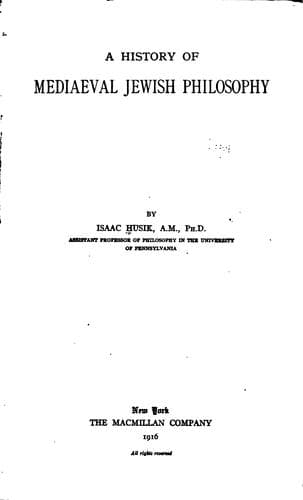
A History of Mediaeval Jewish PhilosophyHusik, Isaac
ReligionJewish
A History of Mediaeval Jewish Philosophy
Husik, Isaac
Philosophy, Jewish; Philosophy, Medieval
There is still a possibility that instead of making the world out of
nothing, God made it out of himself, _i. e._, that it emanated from him
as light from the sun. This, as we know, is the opinion of the
Neo-Platonists; and Israeli comes very close to it as we saw before (p.
6). Saadia is strongly opposed to any such doctrine.
It is unlikely, he says, that an eternal substance having neither form,
condition, measure, place or time, should change into a body or bodies
having those accidents; or that a wise being, not subject to change or
influence, or comprehensibility should choose to make himself into a
body subject to all of these. What could have induced a just being who
does no wrong to decree that some of his parts should be subject to such
evils as matter and material beings are afflicted with? It is
conceivable only in one of two ways. Either they deserved it for having
done wrong, or they did not deserve it, and it was an act of violence
that was committed against them. Both suppositions are absurd. The fact
of the matter is that the authors of this opinion to avoid the theory of
creation _ex nihilo_ went from the frying pan into the fire. To be sure,
creation out of nothing is difficult to conceive, but this is the reason
why we ascribe this power to God alone. To demand that we show how this
can be done is to demand that we ourselves become creators.[57]
The question what existed in place of the earth before it was created
evinces ignorance of the idea of place. By place is meant simply the
contact of two bodies in which the one is the place of the other. When
there is no earth and no bodies there is no such thing as place.
The same thing applies to time. Time means the persistence of existing
things in heaven and earth under changing conditions. Where there is no
world, there is no time. This answers the objection raised by some,
namely, how is it possible that before all these bodies were made time
existed void of objects? Or the other difficulty which is closely
related, viz., Why did not God create the world before he did? The
answer to both is, there was no before and there was no time, when the
world was not.
The following question is a legitimate one, Why did God create all
things? And our answer is, there was no cause which made him create
them, and yet they were not made in vain. God wished to exhibit his
wisdom; and his goodness prompted him to benefit his creatures by
enabling them to worship him.[58]
Public-domain text, read in full here on John Shaqi.
Reviews
Reviews
No reviews yet
Be the first to share your thoughts on this work.
Elsewhere in the archive
Join the Discussion
Join the discussion
Sign in to leave a comment or review.
Sign InorCreate an account