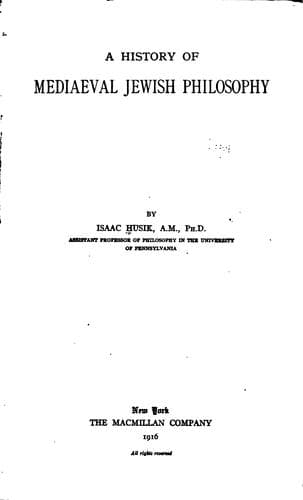
A History of Mediaeval Jewish PhilosophyHusik, Isaac
ReligionJewish
A History of Mediaeval Jewish Philosophy
Husik, Isaac
Philosophy, Jewish; Philosophy, Medieval
The laws which God gave us through the prophets consist of two groups.
The first embraces such acts as our reason recognizes to be right or
wrong, good or bad, through a feeling of approval or disapproval which
God planted in our minds. Thus reason demands that a benefactor should
receive in return for his goodness either a kind reward if he needs it,
or thanks if he needs no reward. As this is a general demand of the
reason, God could not have neglected it in his own case, and hence the
commandments that we should serve him, that we should not offend or
revile him and the other laws bearing on the same subject.
It is likewise a demand of the reason that one should prevent the
creatures from sinning against one another in any way. Murder is
prohibited because it would lead to the destruction of the race and the
consequent frustration of God's purpose in creating the world.
Promiscuous association of the sexes is prohibited in order that man may
be different from the lower animals, and shall know his father and other
relatives that he may show them honor and kindness. Universal stealing
would lead to indolence, and in the end would destroy itself when there
is nothing more to steal. In a similar way we can explain all laws
relating to social dealings among mankind.
The second group of laws has reference to acts which are inherently
neither right nor wrong, but are made so by the act of God's commandment
or prohibition. This class may be called _Traditional_ in contrast to
the first, which we shall name _Rational_.
The traditional laws are imposed upon us primarily so that we may be
rewarded for obeying them. At the same time we shall find on careful
examination of these laws that they also have a rational signification,
and are not purely arbitrary. Thus the purpose of sanctifying certain
days of the year, like Sabbaths and holy days, is that by resting from
labor we may devote ourselves to prayer, to the acquisition of wisdom,
and to converse with our fellows in the interest of religion. Laws of
ceremonial purity have for their purpose to teach man humility, and to
make prayer and the visitation of holy places more precious in his eyes
after having been debarred from his privileges during the period of his
uncleanness.
It is clear that we should not know how to perform the traditional
commandments without divine revelation since our own reason would not
have suggested them. But even in the case of the rational laws the
general principles alone are known to us from our own reason but not the
details. We know in general that theft, unchastity, and so on, are
wrong, but the details of these matters would lead to disagreement among
mankind, and hence it was necessary that the rational laws also be
directly communicated to us by divine messengers.
Public-domain text, read in full here on John Shaqi.
Reviews
Reviews
No reviews yet
Be the first to share your thoughts on this work.
Elsewhere in the archive
Join the Discussion
Join the discussion
Sign in to leave a comment or review.
Sign InorCreate an account