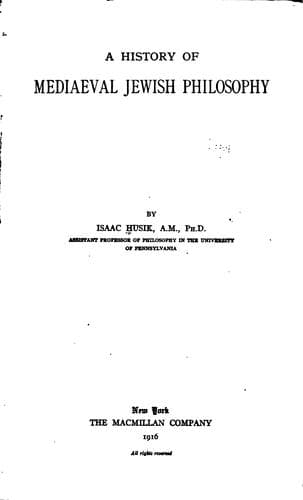
A History of Mediaeval Jewish PhilosophyHusik, Isaac
ReligionJewish
A History of Mediaeval Jewish Philosophy
Husik, Isaac
Philosophy, Jewish; Philosophy, Medieval
With regard to the first question two extreme positions are possible,
which were actually held by Mohammedan schools of Al-Basir's day. One is
that nothing is good or bad in itself, our reason not recognizing it as
such; that the divine command or prohibition makes the thing good or
bad. Hence, the representatives of this opinion say, God, who stands
above his commands and prohibitions, is not bound by them. Good and bad
hold for the subject, not for the author. The acts of God do not come
within the classification, and hence it is possible that God may do what
we regard as injustice. Some, in their endeavor to be consistent and to
carry the argument to its last conclusion, did not even shrink from the
_reductio ad absurdum_ that it is possible God may lie; for, said they,
if I promise a boy sweetmeats and fail to keep my promise, it is no
worse than if I beat him.
For this school there is no problem of evil, because ethical
distinctions do not apply to God's doings. Whatever God does is good.
The other school came under the influence of Greek thought and
identified the idea of God with the idea of the Good. They maintained
that from the nature of God's essence it was not only his duty to do the
good, but that it was impossible for him to do anything else. Doing good
is a necessity of his nature, and our good and evil are also his good
and evil. Ethical values are absolute and not relative.
Neither of these radical views can be maintained. The first is refuted
by its own consequences which only very few of its advocates were bold
enough to adopt. The possibility of God telling a falsehood, which is
implied in the purely human validity of good and evil, is subversive of
all religion. God would then cease to be trustworthy, and there would be
no reason for giving him obedience. Besides, if revelation alone
determines right and wrong, it would follow that if God chose to reverse
his orders, our moral judgments would be turned the other way around,
good would be evil, and evil good. Finally, if good and bad are
determined by the will of God only, those who do not believe in
revelation would be without an idea of right and wrong, but this is
manifestly not true.
But the other opinion, that God is compelled by the necessity of his
nature to do the good, is also erroneous. In the first place it detracts
from God's omnipotence to say he cannot do wrong. Besides, if he is
compelled by an inner necessity to do the good, he must always have done
this, and the world would have existed from eternity. It is just as
wrong to say that it is the duty of God to do what is good and useful
for man. For this is due to a confusion of the good or generous with the
obligatory. Any deed to which no blame attaches may be called good. If
no praise attaches to it either, it is indifferent. If it is deserving
of praise and its omission does not call forth blame, it is a generous
act. A duty is an act the omission of which deserves blame.
Public-domain text, read in full here on John Shaqi.
Reviews
Reviews
No reviews yet
Be the first to share your thoughts on this work.
Elsewhere in the archive
Join the Discussion
Join the discussion
Sign in to leave a comment or review.
Sign InorCreate an account